Here’s what typically happens. A company spends six figures on a GenAI platform license. HR schedules a two-hour “Intro to AI” session. Someone from IT demos prompt engineering. A Slack channel gets created. And three months later, usage is down 60% and the CFO is asking what they got for their money.
Sound familiar? It should. It’s the same playbook companies have run for every enterprise technology rollout for twenty years—ERP, CRM, collaboration tools, you name it. Procure, train, declare victory. The problem is that GenAI isn’t an enterprise software rollout. It’s a capability. And the difference between those two things is the difference between an enterprise GenAI training program that actually changes how your organization works and one that becomes a line item nobody can justify at renewal.
The “Deploy and Pray” Problem
Most enterprise GenAI training programs today look like product onboarding. Here’s the interface, here’s how to write a prompt, here’s a sandbox, go play. The assumption is that once people know how the tool works, they’ll figure out the rest.
They won’t.
Showing a procurement analyst how to use ChatGPT isn’t the same as teaching them to rethink sourcing workflows. Walking a legal team through summarization features doesn’t mean those lawyers suddenly know how to weave AI-generated analysis into their review process with the right professional judgment. There’s a massive gap between knowing what GenAI can do and actually doing meaningful work with it. And tool-centric training doesn’t close that gap. It barely acknowledges it exists.
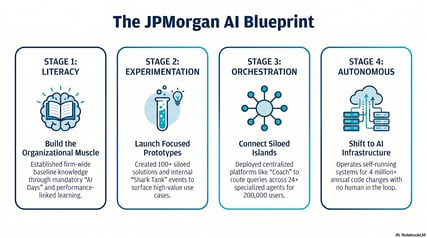
JPMorgan Chase figured this out early. When they rolled out their internal LLM Suite to 200,000+ employees, they didn’t just hand people a login. They took a “learn by doing” approach—putting the tools directly in people’s hands, tied to actual work. Their wealth management unit reported analysts saving two to four hours per day on tasks that used to be pure grunt work. Their call center agents got EVEE, an AI tool that answers internal policy questions in real time so reps don’t have to dig through documentation while a frustrated customer waits on the line. That’s not a training outcome. That’s a capability outcome. And it came from 450+ use cases, each with clear KPIs and test-and-control groups to measure real impact.
GenAI Isn’t a Tool. It’s a Muscle.
Think about how organizations built other capabilities over the past decade. Data literacy didn’t happen because someone ran a workshop on SQL. Agile didn’t take root because a VP forwarded a PDF about sprints. Design thinking didn’t embed itself in product teams after a lunch-and-learn. Each of those took years of sustained, progressive investment in how people think and work—not just in the tools they use. And frankly, most companies still aren’t great at any of them. Which should tell you something about how hard capability building actually is.
GenAI is the same. Except most companies are treating it like it’s different.
An enterprise GenAI training program designed for capability—not just competence—starts from a different question. Instead of “How do we get people to use this tool?” it asks “How do we build the organizational muscle to work differently?” That shift changes everything: the curriculum, the timeline, the success metrics, the level of executive sponsorship required.
And here’s the part most training vendors won’t tell you: GenAI fluency isn’t binary. Some people will become power users who redesign entire workflows. Others will integrate AI into two or three specific tasks. Some will need months of repeated, contextualized exposure before they change anything. A real enterprise GenAI training program accounts for all of these people and builds pathways for each.
What This Looks Like in Practice
Make it role-specific from day one. Generic prompt-engineering workshops are the equivalent of teaching everyone in a hospital the same medical procedure—surgeons, nurses, and administrators alike. Your finance team needs to understand AI-enhanced forecasting and anomaly detection. Your marketing team needs content ideation and audience analysis workflows. Your supply chain people need scenario modeling. An enterprise GenAI training program built for capability adoption meets people where their actual work happens, not in a generic classroom.
Treat prompt craft like a practiced skill, not a lecture. The ability to get useful output from a GenAI system is closer to a craft than a procedure. It improves with practice, iteration, and peer feedback—not PowerPoint slides. The best programs build in regular practice sessions, shared prompt libraries that evolve over time, and team-level review of what’s working. When Amazon rolled out its internal AI coding assistant, the real gains didn’t come from the initial training. They came from developers building on each other’s approaches over weeks and months.
Build knowledge loops that compound. When one team figures out how to use AI for contract analysis, that insight should flow to every team dealing with document-heavy workflows. When a sales team develops a prompting strategy that improves proposal quality, every revenue-facing function should have access to it. An enterprise GenAI training program built for capability adoption includes mechanisms—internal case libraries, cross-functional showcases, regular retrospectives—that turn individual experiments into organizational intelligence. Most companies skip this entirely. They train people, then let the knowledge evaporate.
Measure capability, not activity. Here’s where most programs go wrong. They track logins. Session completions. Workshop attendance. These are activity metrics. They tell you nothing about whether the organization is actually building capability. Better: what percentage of teams have redesigned at least one workflow using AI? How has the quality of AI-augmented outputs changed compared to pre-adoption baselines? Are employees self-directing their own experimentation without IT holding their hand? IDC estimates the global AI skills gap costs $5.5 trillion in lost productivity. Activity metrics won’t close that gap. Capability metrics might.
Plan for phases, not a launch date. Capability building is progressive. Phase one is foundational literacy: what GenAI is, what it can’t do, how to interact with it safely. Phase two is applied practice within specific roles. Phase three targets workflow redesign and process transformation. Phase four embeds continuous learning as the models themselves evolve—because what works with GPT-4 won’t necessarily work the same way with the next generation. Companies that try to compress all of this into a single quarter end up with adoption that looks great in a board deck and disappears within six months.
Your First 90 Days
If you’re an AI or digital transformation lead tasked with standing up an enterprise GenAI training program, here’s where to start.
First, run a capability baseline. Not a survey about who’s “excited about AI.” An actual assessment of where your teams are in terms of literacy, comfort, and practical application. You’ll find the distribution is wider than you think.
Second, pick three to five high-value use cases where GenAI can deliver visible, measurable impact within specific functions. These become your anchor cohorts. Don’t try to train the whole company at once. Train the people who can prove the model works, then let their results pull others in.
Third—and this is the one people skip—get executive sponsorship that frames this as a capability investment, not a technology project. The language matters more than you think. When leadership talks about GenAI as “a capability we’re building,” it signals patience and strategic importance. When they call it “a tool we’re rolling out,” it signals a deadline, a checkbox, and eventual deprioritization.
Bottom Line
Only 33% of employees have received any formal AI training. Meanwhile, trained employees perform 2.7x better than self-taught ones. The gap between “has access to GenAI” and “knows how to do real work with GenAI” is where the actual competitive advantage lives. And it’s a gap that’s getting wider, not narrower, as models get more powerful and the bar for effective use keeps rising.
The companies that win won’t be the ones with the most sophisticated models or the biggest platform deals. They’ll be the ones that built GenAI into how their people think and work. That takes an enterprise GenAI training program designed as a sustained capability effort—not a technology onboarding exercise that everyone forgets about by Q3.
In our advisory work across industries, the pattern is consistent: the single biggest barrier to AI integration isn't data quality, security, or budget—it's the skills gap. We've seen enterprises spend six figures on model access before a single business unit leader could articulate what success looks like. We've watched AI initiatives stall not because the technology failed, but because middle management lacked the capability to redesign workflows around it. In our RISE maturity framework, this is the chasm—the gap between isolated Islands of Innovation and true enterprise-wide Scaling that most organizations cannot cross without sustained capability investment. Companies know training matters. They're just solving it wrong. A real enterprise GenAI training program isn't a course catalog. It's an operating system for how your organization learns to work with AI.
The market has already decided that GenAI training matters. The only question left is whether yours is going to build a lasting capability or just check a box.

 GAI Insights Team