
 GAI Insights Team
How To Create An AI Agent In ChatGPT To Proofread PowerPoint In 3 Minutes
If you’re like me, you spend a fair amount of time creating PowerPoint presentations for internal and customer meetings. Tools like ChatGPT can...

Walmart announced a partnership with OpenAI that enables customers to shop Walmart through ChatGPT using Instant Checkout. This pushes retail discovery and purchase into conversational interfaces, which will change how brands win recommendations.
What it means for retailers:
The “AI assistant” becomes a new gatekeeper for product discovery
Product data quality and trust signals matter more than ad copy
Brands will need “AEO for commerce”: structured attributes + proof + consistency
In a move that sent shockwaves through the retail and tech industries, Walmart, the behemoth of brick-and-mortar, announced a groundbreaking partnership with OpenAI's ChatGPT. This collaboration is far more than just another tech integration; it's a paradigm shift that promises to fundamentally reshape the landscape of e-commerce, granting ChatGPT unprecedented access to a treasure trove of consumer data while presenting both immense opportunities and existential threats to retailers of all sizes.
At its core, the partnership will allow consumers to "chat and buy" directly within the ChatGPT interface. This seemingly simple functionality masks a profound transformation in the online shopping experience. Gone are the days of navigating clunky search bars and endless product grids. Instead, picture this: a user planning a weekend camping trip can simply converse with ChatGPT, outlining their needs, preferences, and budget. The AI, in turn, can curate a personalized shopping list, offer product recommendations, compare features, and ultimately, facilitate the purchase of everything from a tent to trail mix, all fulfilled by Walmart. And, these interactions are part of an ongoing memory and profile of the shopper and the shopper’s family. This could create an unbelievable competitive moat as they amass hundreds of millions of deep profiles of individuals over time.
 To grasp the magnitude of this partnership, one must first remember the sheer scale of Walmart’s operations. The company is not just a retailer; it’s an economic force of nature. For its fiscal year 2025, Walmart’s global revenue is projected to reach a staggering $681 billion, as big as the GDP of Argentina. In the United States alone, Walmart commands a 6.04% share of the entire retail market, a figure that swells to an even more dominant position in key categories like groceries.
Consider this: approximately 90% of the U.S. population lives within 10 miles of a Walmart store. The company’s vast network of over 5,200 stores in the U.S. serves as a crucial artery for the flow of consumer goods. This physical footprint, combined with a rapidly growing e-commerce presence, means that a significant portion of American disposable income funnels through Walmart’s registers. OpenAI claims a weekly active user count of 800,000,000 souls. This partnership, therefore, isn't just about selling goods online; it's about integrating a powerful AI into the very fabric of American consumption.
For OpenAI, this partnership is a game-changer. While ChatGPT has been trained on a vast corpus of text and code from the public internet, its understanding of real-time, granular consumer behavior has been largely theoretical. The Walmart integration will provide a direct firehose of commercial data, offering invaluable insights into:
This newfound "commercial consciousness" will undoubtedly enhance ChatGPT’s capabilities across the board, making it a more intuitive and effective assistant. However, it also raises important questions about data privacy and the responsible use of this powerful new tool.
The ripples of this partnership will be felt by every player in the retail ecosystem. For sellers, from multinational corporations to mom-and-pop shops, the implications are profound and demand immediate strategic consideration.
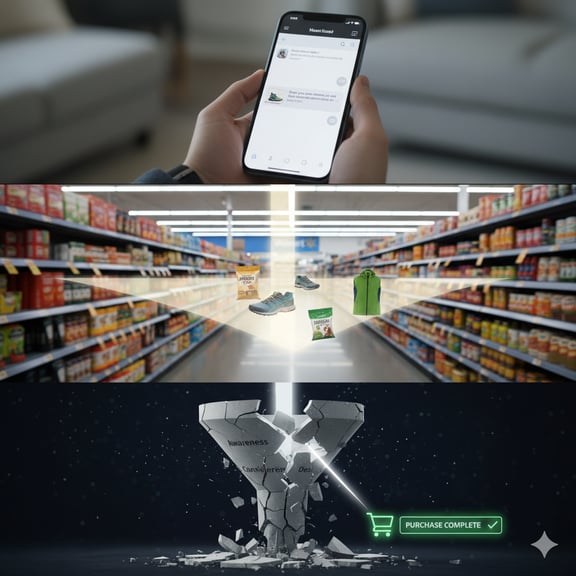
For decades, the primary focus of product marketing has been on capturing the attention of human consumers. Google ushered in a whole new science of Search Engine Optimization (SEO), funneling hundreds of billions of dollars into that advertising approach. With the advent of conversational commerce powered by AI like ChatGPT, that focus must now be shared with the algorithm. The AI will become a powerful gatekeeper, curating and recommending products based on its understanding of a user's needs and its own internal logic.
This means that product descriptions, specifications, and even brand storytelling will need to be optimized for AI comprehension – what Pete Blackshaw of Brandrank.AI calls Answer Engine Optimization (AEO). Sellers who can effectively "teach" the AI about their products' unique value propositions will have a significant advantage. This will likely give rise to a new field of "AI-search optimization," where the goal is not just to rank high on a search engine results page, but to be the top recommendation in a conversational exchange.
The era of mass marketing is officially over. The Walmart-ChatGPT partnership signals the dawn of hyper-personalized commerce at an unprecedented scale. The ability of the AI to understand individual needs and preferences in real-time will create an expectation of a "conversation of one" between the consumer and the retailer.
For sellers, this means that generic marketing messages and one-size-fits-all promotions will become increasingly ineffective. The future lies in leveraging data to deliver tailored recommendations, dynamic pricing, and personalized content that speaks directly to the individual consumer's context. This will necessitate a deeper investment in data analytics and AI-powered marketing tools to keep pace.
The traditional sales funnel, with its distinct stages of awareness, consideration, and conversion, is being rapidly compressed. Google dominated the search function in the Western economies. Now, instead of buying attention through ad words, brands need to make their case through content – theirs and others, including Reddit, Wikipedia, and a sea of others. In a conversational commerce environment, a consumer can move from a vague notion of a need to a completed purchase in a matter of minutes, all within a single chat interface – informed by the entire internet.
This has significant implications for how brands engage with customers. The focus will shift from guiding consumers through a linear funnel to being present and helpful at every moment of the conversational journey. This means providing rich product information that can be easily accessed and understood by the AI, offering instant customer support through chatbots, and creating a seamless and frictionless path to purchase. We don’t yet know these conversational purchasing dynamics, which is why firms must experiment now.
The Walmart-ChatGPT partnership is more than just a technological curiosity; it’s a harbinger of a new era of intelligent commerce. navigated with conversations. As AI becomes more deeply integrated into our daily lives, the way we shop, discover products, and interact with brands will be irrevocably changed.
For consumers, this Walmart/ChatGPT partnership promises a future of greater convenience, personalization, and efficiency. For retailers and sellers, it presents a stark choice: adapt to this new reality and find your way into these rivers of conversation or risk being left behind. The companies that thrive in this new landscape will be those that embrace the power of AI, understand the importance of data, and, most importantly, never lose sight of the human at the other end of the conversation. The retail revolution will not be televised; it will be conversational.
1) What did Walmart announce with OpenAI and ChatGPT?
Walmart announced a partnership with OpenAI that will let customers complete Walmart purchases directly inside ChatGPT using Instant Checkout.
2) How does “chat and buy” work inside ChatGPT?
A shopper describes what they need in natural language, ChatGPT recommends Walmart products, and the shopper can complete the order within the chat flow through Instant Checkout.
3) Why is this a big shift for e-commerce discovery?
Discovery moves from search pages and product grids to an AI assistant that curates options and explains trade-offs. The products that get recommended are often the ones the assistant can understand and compare confidently.
4) What is Answer Engine Optimization (AEO) for retail and brands?
AEO is optimizing how your brand and products show up in AI-generated answers and recommendations by making your product information easy for AI systems to interpret and trust.
5) What should brands optimize first to win in AI shopping?
Start with “product truth”: clean titles, accurate attributes, variant structure, compatibility/sizing, specs, strong images, and consistent descriptions across your site and marketplaces. Then add trust signals like reviews, comparisons, and clear policies.
6) What metrics should brands track to know if they are winning?
Track share of AI recommendations (how often you appear), AI-driven referral traffic quality, conversion rate from AI sessions, and product data errors that cause returns, complaints, or drop-offs.
If you’re like me, you spend a fair amount of time creating PowerPoint presentations for internal and customer meetings. Tools like ChatGPT can...

ChatGPT is increasingly sending real referral traffic to websites because its answers...
CEOs and leadership teams can’t afford to “dabble” in GenAI from the sidelines. To really understand its impact, they need a secure way to use AI...