
 GAI Insights Team
6 Things CEOs Need To Do In This Age of AI
AI is evolving at an unprecedented pace. In just a few years, 20-30% of jobs paying $100,000 or more could be at risk. But the conversation shouldn’t...

Model costs are dropping and capabilities are shifting weekly. If your leadership team is relying on quarterly reports, you aren't leading—you’re reacting.

There was a time when an executive could delegate technology decisions to the CTO and check in quarterly. That era is over. Generative AI touches pricing strategy, workforce planning, competitive positioning, and capital allocation—often simultaneously. When a new model drops inference costs by half, that is not a technology update. It is a signal that business cases rejected six months ago may now be viable.
Yet most C-suite leaders are navigating this landscape with tools designed for a slower era. Quarterly analyst reports. Vendor briefings optimized to sell, not inform. Internal updates filtered through team priorities and blind spots. The result is a growing gap between how fast AI moves and how quickly leadership can act on what matters. Closing that gap is exactly what a GenAI intelligence brief for executives is built to address.
Consider the information diet of a typical CEO trying to stay current on AI. They receive analyst subscriptions that deliver comprehensive but slow-moving analysis, often months behind the cutting edge. Their AI lead provides project updates that reflect internal progress, not market shifts. Their vendors offer roadmaps designed to reinforce buying decisions already made. Their LinkedIn feed surfaces whatever the algorithm decides is engaging, which is rarely what is strategically important.
Each of these sources carries a structural bias. None of them are designed to answer the question that matters most at the leadership level: What changed this week that should influence how we allocate resources, set priorities, or position ourselves competitively? That question is the starting point for any meaningful GenAI intelligence brief for executives.
This is not a criticism of any one source. It is an observation that the information architecture around most executive teams was built for a world where technology shifts happened over quarters and years, not weeks. Generative AI broke that cadence, and most leadership teams have not adapted.
The consequences of this gap are not abstract. They show up as missed opportunities and avoidable missteps—the kind of issues that structured intelligence would surface before they become costly. A few examples from patterns visible across industries:
The organizations pulling ahead in the AI era share a common trait. It is not the size of their AI budget or the prestige of their technical hires. It is the speed of their insight loop—the time between “something meaningful changed” and “we adjusted our approach.” In some companies, that loop takes months. A development surfaces in a vendor briefing, enters a planning cycle, and eventually influences a decision long after the window of advantage has closed.
In the most effective organizations, that loop is compressed to days. Not because executives are spending hours reading research, but because they have structured mechanisms that filter the noise and surface what is strategically relevant. This is what a GenAI intelligence brief for executives is designed to do—compress the distance between what is happening in the market and what the leadership team does about it.
There is no shortage of AI newsletters and news aggregators. What is in short supply is intelligence that is filtered through the lens of a specific industry, competitive set, and stage of AI maturity. This is where a GenAI intelligence brief for executives differs from general coverage. A new agentic AI framework means something different to a financial services CEO than it does to a manufacturing COO. A regulatory shift in the EU carries different urgency depending on where an organization operates and how exposed its AI deployments are.
Generic coverage treats every development with equal weight. A well-constructed GenAI intelligence brief for executives applies judgment—distinguishing between what requires immediate attention, what represents a trend worth monitoring, and what is noise. That editorial layer is what transforms information into something an executive can act on.
The goal is not to turn every executive into an AI expert. The goal is to ensure that leaders responsible for strategy and capital allocation have a reliable, recurring source of insight that keeps them calibrated to a fast-moving landscape. The best version of this looks like a GenAI intelligence brief for executives that arrives weekly, takes less than ten minutes to absorb, and answers three questions: What changed? Why does it matter to us? What should we consider doing differently?
This is not a radical concept. Intelligence briefings have been standard practice in government, defense, and financial markets for decades. When the environment moves faster than your planning cycle, you need a structured mechanism to keep decision-makers current. Generative AI is now that kind of environment, and a GenAI intelligence brief for executives applies this proven model to the fastest-moving domain in business today.
The risk facing today’s C-suite is not that they will make the wrong AI bet. It is that they will make decisions based on a picture of the landscape that is weeks or months out of date. In a domain moving this quickly, that lag is not a minor disadvantage. It is the difference between leading and reacting. A GenAI intelligence brief for executives exists to eliminate that lag.
A GenAI intelligence brief for executives does not replace strategy. It makes strategy possible by ensuring the people setting direction have a current, contextualized, and honest view of the terrain. The executives who will navigate this era most effectively are not the ones who know the most about AI. They are the ones who consistently know what matters most—right now—for their business.
That clarity is not a luxury. In a landscape that reinvents itself weekly, it is the minimum requirement for informed leadership.
AI is evolving at an unprecedented pace. In just a few years, 20-30% of jobs paying $100,000 or more could be at risk. But the conversation shouldn’t...
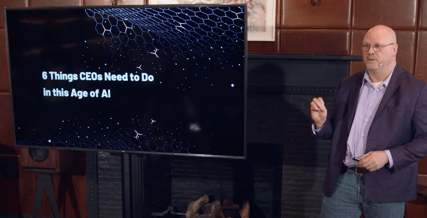
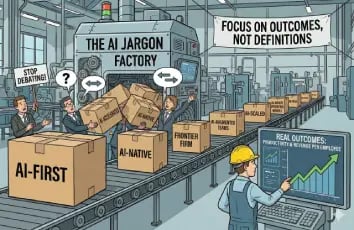
Consultants can argue endlessly about whether a company is “AI-first,” “AI-native,” or “AI-accelerated.”...
For the love of green beans and other good food everywhere, can we please stop using the term "hallucination" when talking about Generative AI? It’s...