
 GAI Insights Team
Turbocharging Organizational Capability With GenAI: A Senior Executive’s Playbook
Why move now
GenAI isn’t just faster content creation — it’s a force multiplier for organizational learning. When people and machine agents...

Early evidence suggests that Generative AI is reducing some entry-level work that is easy to standardize and automate. The career response is to become a “hybrid” worker: use AI tools to produce faster, higher-quality output and prove it with examples.
Key takeaways:
Entry-level, repeatable tasks are impacted first because they are easiest to turn into workflows.
AI adoption often moves from augmentation to partial automation as processes get structured.
Workers who can use and supervise AI effectively become more valuable, not less.
Prof. Erik Brynjolffson of Stanford and his colleagues have just released a beautifully constructed study on the effects of GenAI on employment. They found that since late 2022, there has been a 13% decrease in employment in those jobs that are likely to be automated, not just augmented by AI. Similar data from SignalFire, the San Francisco-based venture capital firm, says the entry-level tech jobs fell 25% in big tech firms in 2024.
It is only early days for the implementation of Generative AI and AI, yet we are already seeing the automation of entry-level tasks and basic knowledge work. In previous Forbes articles (Your Next Co-Worker Is Going To Be A Robot and AI Agents and The Hybrid Organization), I’ve argued that we are beginning the fundamental redesign of traditional organizations into hybrid organizations with a combination of digital and human workers. It makes sense that the entry-level jobs are the first to be hit because the potential employees don’t have any specific knowledge about the company yet, and they don’t have any organizational power.

My prediction is that Generative AI and AI will progressively structure more and more jobs so those that begin with augmentation, will progress to partial or complete automation and the very top level jobs with deep expertise and insight will evolve to small teams of 3-6 people along with dozens or hundreds of robots will be doing the work of hundreds or thousands of traditional workers. We have seen special forces troops with amazing training and equipment perform tasks that would have taken an order of magnitude or more regular army troops.
Karl Marx was right in that capital will continue to substitute for labor in the growth of the modern enterprise. As the billionaire inventor of Mathematica, Steven Wolfram said, and I paraphrase, “Large language models are the first major breakthrough in our understanding of the structure of human language since Socrates’s invention of logic.” This deeper understanding is allowing a capital substitution for labor in knowledge work that we have never seen before.
These early data points to an entirely new way that organizations will create and apply knowledge and expertise. Frederick Taylor, the Father of Scientific Management, was the man who worked hand in glove with Henry Ford to invent the modern commercial enterprise. He would watch the very best worker, figure out their method of work, and teach that knowledge to everyone. Generative AI systems not only can do that, but they can also explain themselves to a person using them. We’ve never had a knowledge management system like this. Today I can take my cell phone, point it at my boiler, and it can tell me my make, model, and how to fix it 9 times out of 10.

Where will all this go concerning employment? I’m starting to see some employers interview the candidate and their robots. CustomGPT.AI is a firm that sells an easy-to-use AI platform and agents that enable firms to create their own knowledge bases to power chatbots and agents with their own data.
When Alden deRosario, the CEO and founder of CustomGPT, interviews new talent, he asks about their background, but also asks to see the candidate’s robots. He wants to know what robots the interviewee uses to make themselves more productive. Robot creation is the easiest way for a young person with no experience to be considered for a new profession. Put another way, robots are a proxy for experience in the field.
I hear from my friends who own restaurants that one would never hire a chef who did not have his or her own knives. Today, every entry-level knowledge worker in a domain susceptible to Generative AI automation or augmentation will be well served to think about how they can make themselves more productive by learning how to modify or build tools to help them do their work. The ability to harness these tools will be essential to becoming valuable to a potential employer. If a person or a loved one is early in their career, they'd better robot-up soon. The entry-level jobs are receding even faster than the Great Salt Lake is drying up!
1) Is Generative AI actually reducing entry-level jobs?
Early research and industry analyses suggest declines are showing up first in roles with repeatable tasks that can be standardized and automated. The exact magnitude varies by function and company, but the direction of change is now visible in the data.
2) What is the difference between AI augmentation and AI automation?
Augmentation means AI assists a worker while the human remains responsible for the core task and decisions. Automation means AI completes most of the workflow end-to-end, with the human mainly supervising, checking, or approving.
3) Why are entry-level roles impacted before senior roles?
Entry-level work often starts with standardized tasks, internal reporting, and draft creation—work that is easiest to structure into templates. Senior roles rely more on judgment, context, relationships, and accountability, which are harder to automate.
4) What is a “robot posse” in career terms?
A “robot posse” is a personal set of AI tools, prompts, templates, and small automations you use to produce better work faster. It is proof that you can operate as a hybrid worker and deliver outputs with quality control.
5) What should a student or early-career professional do in the next 30 days?
Pick one role and 2–3 outcomes you want to produce (briefs, analyses, emails, reports). Build repeatable AI workflows for them and add a verification checklist (facts, numbers, sources), then publish 1–2 before/after examples as a portfolio.
6) How do you avoid AI mistakes and hallucinations at work?
Use AI on tasks where you can verify outputs, require sources for factual claims, and check numbers and assumptions explicitly. Treat AI as a draft generator, not a final authority, especially for decisions or external-facing work.
This article was also published as Forbes column on 29 August 2025. Check it here.
GenAI isn’t just faster content creation — it’s a force multiplier for organizational learning. When people and machine agents...

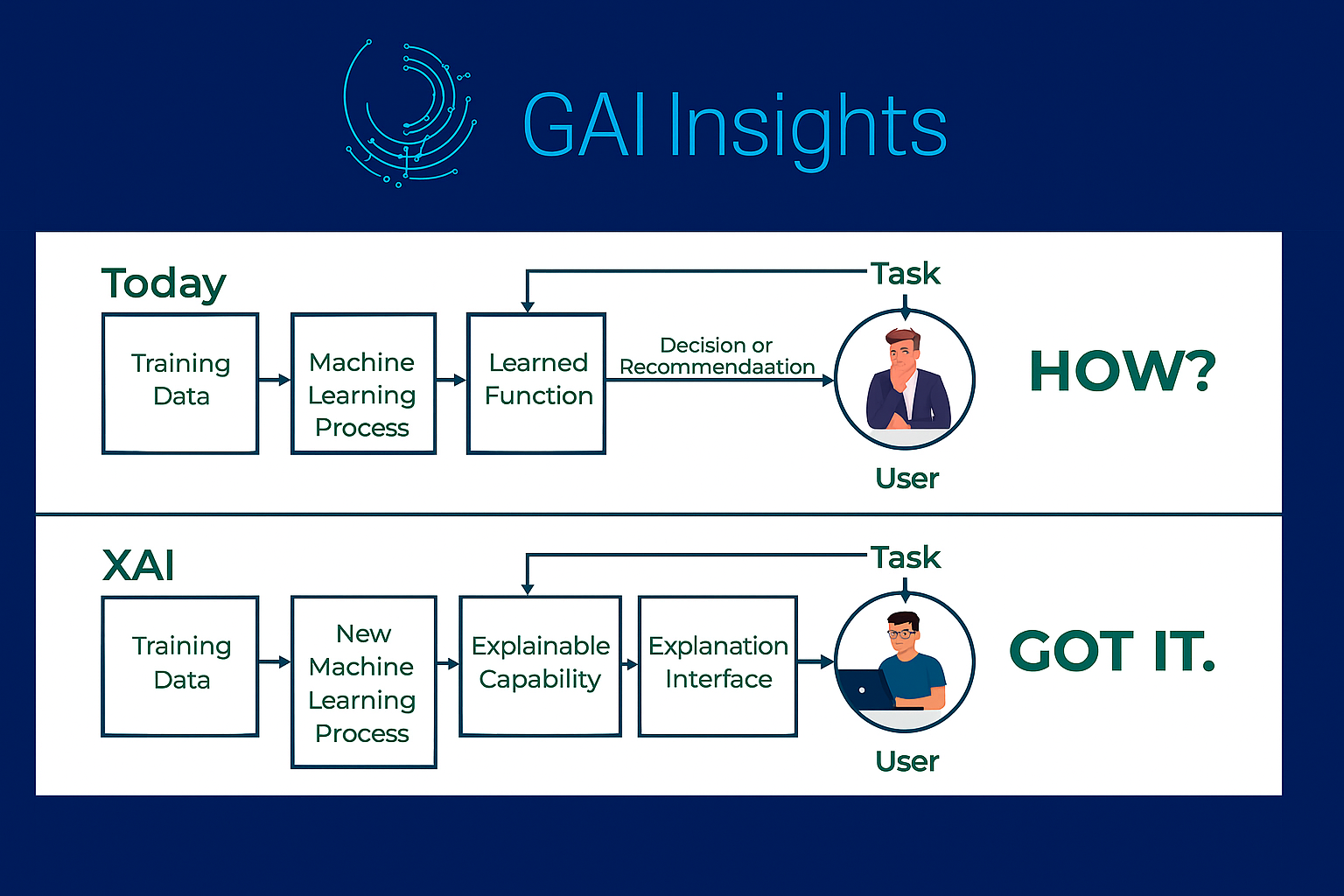
In 2025, it’s not the smartest AI that wins. It’s the one you can explain.
AI has evolved from a...
Some enterprises are standardizing on one secure employee chatbot, and a subset are switching from Microsoft Copilot Chat to OpenAI ChatGPT...