You own your printer. One night it installs a firmware update you never asked for, and the cheaper third-party ink you have been buying stops working. The cartridges are sitting right there in the tray. The printer refuses them. You own the machine. You just learned you do not control it.
In May 2025, Salesforce did the enterprise version of that. It changed the meter on Agentforce, moving from a flat two dollars per conversation to Flex Credits billed at roughly ten cents per action. One action covers up to 10,000 tokens. Cross that line and a single action bills as two, then three. The change arrived the way the firmware update did, on the vendor's schedule rather than yours. If you held a cost-protection clause written for the old model, it protected you only if you could see the new meter move. Most buyers could not. The right was on paper. The ability to use it was not.
This is the gap that decides vendor leverage in enterprise AI, and almost no one prices it correctly. A contract sets your rights on paper. Your architecture decides whether you can exercise them. Leverage is neither one alone. It lives in the overlap, in the rights you can actually enforce and operationalize.
We evaluate enterprise AI platforms for a living, and the pattern is consistent across the companies we advise. Legal teams negotiate hard for exit rights, spend caps, no-training promises, and portability. Engineering teams, working on a separate track, wire the stack to one provider's models, formats, and consoles. Each group does its job well. The two outputs never meet until renewal, which is the exact moment a buyer discovers that the rights in the contract describe things the architecture cannot do. The clause is necessary. It is not sufficient. Here are the four places that gap opens, and what closes each one.
The Exit You Cannot Take
Most enterprise AI agreements include a termination right, a transition window, and a promise to return your data. On paper, you can leave. Then you try.
Providers retire models on timelines you do not control. GPT-4.5 went from launch to deprecation in roughly fourteen months, so a workflow tuned to one model can be pointed at a dead endpoint before the project even reaches production. Your exit right governs your relationship with the vendor. It does nothing about the fact that your retrieval system runs on embeddings generated by that vendor's model. An embedding is a set of coordinates in one model's space. Hand it to a different model and it means nothing. Switching providers means re-embedding your entire corpus, re-tuning every prompt to a new model's behavior, and rewiring every workflow that calls the old endpoint by name. The data comes back. The capability does not.
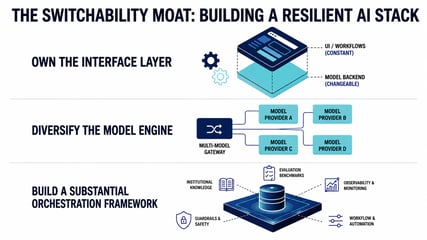
The architecture that makes an exit right real is an abstraction layer that treats the model as a swappable part, where adding or removing a provider is a configuration change rather than a rebuild. Build that, and the exit clause becomes a decision you can make on a Tuesday. Skip it, and the clause is a letter you are not in a position to send.
The Price You Cannot See
The Agentforce repricing was not an outlier. It is the direction of the whole market, away from per-seat pricing you can forecast and toward consumption pricing that scales with how hard the system works. Salesforce itself reports that 90 percent of CIOs say managing AI cost is limiting their ability to create value. New consumption deployments routinely overrun their first-quarter forecast, because test traffic, internal QA, and retry loops all meter, and because actions multiply silently once they cross the token threshold.
A spend cap is a good clause. It is worth exactly what your visibility into consumption is worth. If you cannot watch the meter daily, you learn about the overage when finance does. The pairing that creates leverage is a contract that guarantees you a usage dashboard with daily granularity, a ramp period that keeps sandbox and internal traffic off the bill, and a true-down right if your first full quarter lands below commitment, all backed by your own monitoring that flags price, model, and policy changes as they happen rather than at renewal. Vendors now ship their own consumption dashboards. Use them, and do not rely on them alone. The party that owns the meter sets the terms of the conversation.
The Promise You Cannot Verify
Enterprise agreements from the major providers routinely commit not to train on your prompts, outputs, or data. The commitment is real and worth getting in writing. Your ability to confirm it independently is close to zero. A clause grants you the right to object. Only logging, monitoring, and change detection give you the evidence to act on. Without your own telemetry, a no-training commitment is a statement you accept on trust, and trust is not leverage. It is the absence of a reason to worry, which is a different thing and a more fragile one.
The Data You Cannot Move
Portability clauses promise the right to export, migrate, and rebuild elsewhere. The clause assumes the thing you export is the thing that holds the value. Often it is not. The vendor returns your records. It does not return the prompt libraries tuned to its model, the evaluation benchmarks wired to its API, or the configurations that live in its console. Those are the assets that took a year to build, and in a thin integration they accumulate inside the vendor's system instead of yours.
Artifact ownership is the architectural answer. You keep your own copies of data, prompts, embeddings, and configurations, in portable formats, on your side of the line, generated and stored so they survive a change of provider. You use open formats and standard APIs rather than provider-specific ones. The test is simple. If you exported everything your contract entitles you to tomorrow, could you stand the capability back up somewhere else? If the honest answer depends on the vendor's cooperation, you do not own the artifacts. You are renting them.
From Clause to Control
Closing all four gaps follows one sequence. Negotiate the right, so exit, cost, no-training, and portability are in the contract. Design for ownership, so you hold the artifacts that make those rights usable. Operate with visibility, so you detect model, price, policy, and API changes as they occur. Retain leverage over time, because vendors ship new models and revise terms continuously, and leverage you do not maintain decays. The teams that get this right put their lawyers and their architects in the same room before they sign, and they ask one question of every clause: what does the system have to do for this to be true.
The Through-Line
A contract is a description of rights. An architecture is a description of what you can do. Leverage is the overlap, and the overlap is smaller than most buyers assume, because the clause and the capability are designed by different people who rarely compare notes. The exit right that no abstraction layer supports. The spend cap that no dashboard enforces. The no-training promise that no telemetry verifies. The portability clause that hands back data you cannot rebuild from. Every one of them is the printer refusing the cartridge it was built to use.
The fix is not a better contract. It is an architecture built so that the rights in the contract are things the system can actually do.
Leverage is not written into the contract. It is engineered into the architecture that makes the contract enforceable.
This is one of the dimensions we score in the 2026 Corporate Buyer's Guide to Enterprise AI Platforms: not only what a vendor's terms say, but what your architecture has to do to make those terms real. The decisions are yours. The vendor landscape is what we cover. For more, visit gaiinsights.com.

 GAI Insights Team