
The RISE Framework
A New Model for Growing AI Capability
Most organizations are losing the AI race not because they lack access to technology, but because they’re trying to buy their way into capability. They invest in tools, license platforms, and stand up centers of excellence — yet transformational results remain elusive. The hard trut h is this: capabilities can’t be bought. They must be grown.
The RISE framework is a proven management model that maps the four stages every organization must navigate to build lasting, competitive AI capability. It reflects a fundamental insight drawn from studying how leading enterprises — including JPMorgan Chase — have scaled AI from early experimentation to enterprise-wide transformation.
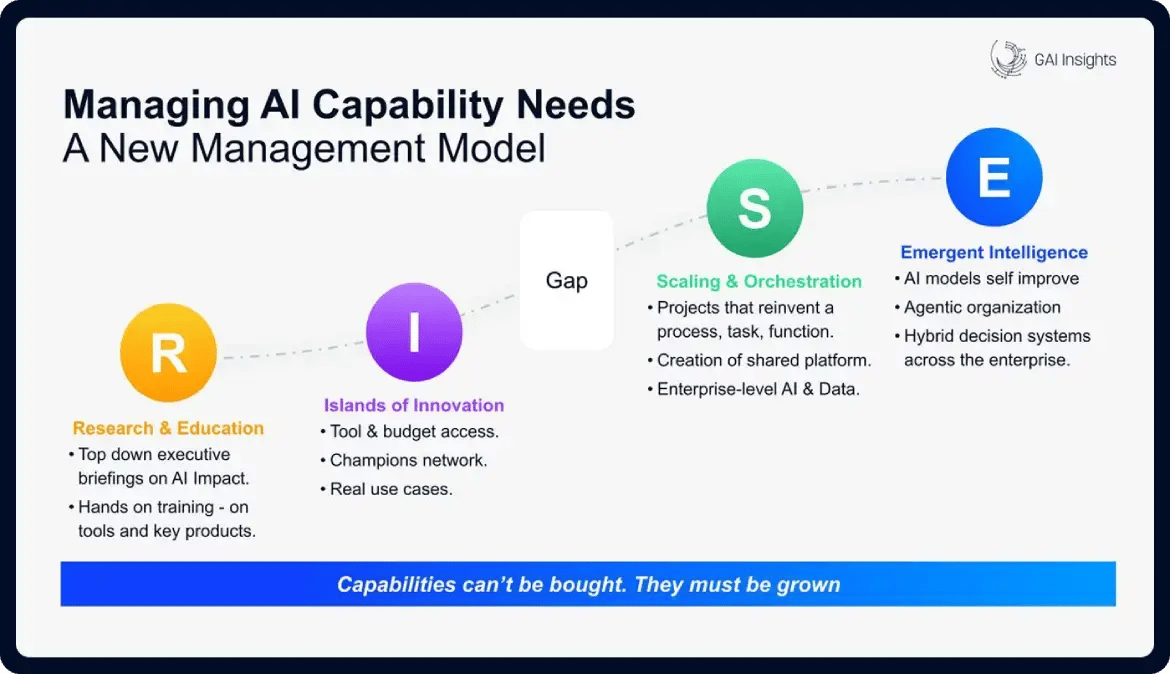

-
+ Research & Education
Every successful AI capability journey begins with deliberate learning. In this first stage, leadership sponsors executive briefings on AI’s business impact, while hands-on training builds fluency with tools and key products across the organization. The goal is not passive awareness but active preparation — creating a leadership team that can make informed decisions and a workforce ready to experiment. Management needs to look at this stage, as an investment.
-
+ Islands of Innovation
With foundational knowledge in place, organizations unlock pockets of real innovation. Champions emerge who have tool and budget access, and networks form around genuine use cases that demonstrate AI’s value in the flow of real work. These islands are essential proving grounds — and build skill as well as knowledge. Many organizations attempt to skip this skill building step, which creates risk of failure at scale. Each island should have an economic case, and management should aim to break even on the portfolio of efforts. The goal here is application of knowledge to real world solutions using AI.
-
+ The Gap
In any AI transformation a gap sits between Islands of Innovation and Scaling. Organizations should not try to hop over the hard work of coordination, governance, and shared infrastructure — fail. You cannot skip steps in capability building. The gap is real, and crossing it requires deliberate organizational commitment.
-
+ Scaling and Orchestration
This is where AI moves from the periphery to the core. Scaling and Orchestration is characterized by projects that fundamentally reinvent processes, tasks, and functions — not just augment them. Shared platforms are built. Enterprise-level data strategies are put in place. Leadership at this stage includes integrator executives who coordinate across the enterprise and architect leaders who design for durability. Measurement shifts to return on investment, successful project delivery, and improving operating metrics. At this phase projects should have a traditional return on investment business case, and project managers need to be help accountable for financial results. The economics and economic leverage of the business should start to improve.
-
+ Emergent Intelligence
The final stage is where AI capability becomes self-sustaining and strategically differentiating. AI models improve autonomously. Agentic systems coordinate across the enterprise without constant human direction. Hybrid human-AI decision-making becomes the operating norm. Leaders at this stage are visionaries reinventing the firm itself and ecosystem executives connecting best practices, suppliers, and talent. The business outcomes are measurable: higher revenue per employee, stronger ROA, and a faster cycle of innovation and learning. At this stage, which we only see fully developed in technology firms, the key operating ratios of the business improve: revenue per employee is up, return on assets is up, growth is up, and speed of innovation is improved.
Why RISE Matters for Leaders
The RISE framework gives executives a shared language, a realistic roadmap, and a fact based view of where their organization stands. It distinguishes activity from progress, and ambition from capability. For C-suite leaders navigating the AI era, RISE provides what most organization change frameworks miss: a sequential, measurable path from curiosity to competitive advantage.