 GAI Insights Team
Leaders, Take Note: Women Are Leading The Way in GenAI Use. Meet the Female Leaders in the Field.
The gender gap in AI isn’t just shrinking—it’s reversing the narrative. Women in GenAI are rewriting the rules, not waiting to be included but...

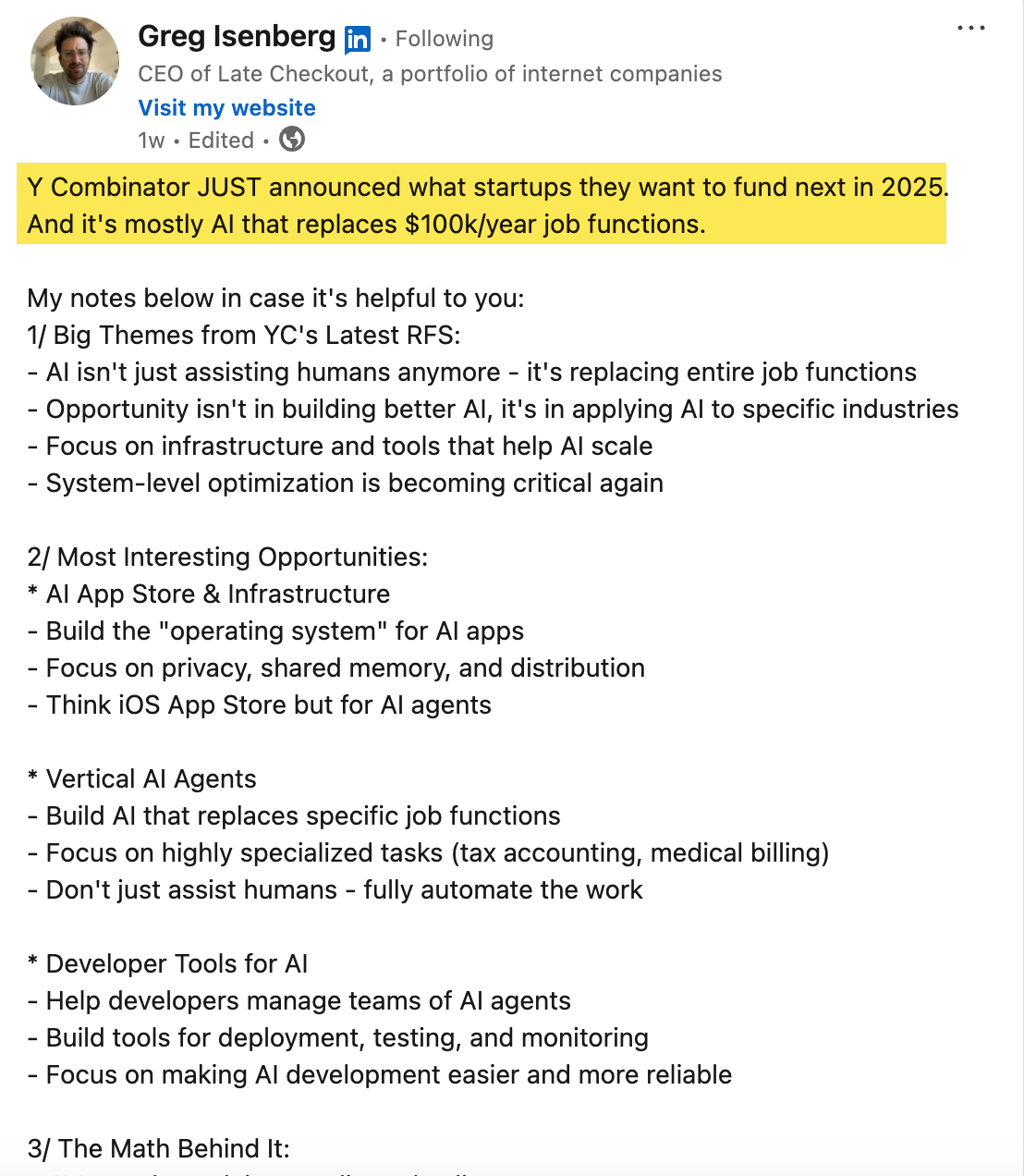
AI startups are increasingly targeting $100K/year knowledge-work roles by automating parts of workflows (not entire jobs). The near-term impact (2025–2027) is mainly headcount avoidance and higher output per employee, driven by new AI tools for coding, sales, ops, and research.
Key takeaways:
The real shift is efficiency: doing the same work with fewer hires or smaller teams.
The biggest near-term gains come from workflow-level automation (draft → review → ship).
Leaders should test tools weekly, run small pilot teams, and track ROI in time-to-output and cost-per-deliverable.
Augmenting and automating high-value cognitive tasks is advancing faster than most investors and executives realize.
The key takeaway from the recent “Davos MIT AI Day” is that we are at a unique moment in human history: within two years, AI will be capable of performing 99% of cognitive tasks better than humans.
Our evolutionary "monkey brains" struggle to grasp the speed and scale of this transformation.
Here’s a list of the 20 most common $100K jobs, with my views on which roles will be most impacted between 2025 and 2027 highlighted in yellow.
VC-backed startups are already capitalizing on this opportunity. Greg Isenberg has noted that automating $100K jobs is now the most popular focus of Y Combinator startups.
To be clear, discussions around "AI eliminating this specific $100K job" are short-sighted. The real conversation is about efficiency and scale. Let’s consider a concrete example:
Imagine a company employs 20 outside sales reps or software developers, each earning $175K per year fully loaded (including salary, benefits, office costs, and equipment), totaling $3.5M annually. Could this workload be augmented with AI while retaining 15 employees, resulting in a cost saving of $875k per year? I argue yes. Over three years, this translates to $2.6M in savings. The cost of AI software, training, and support is significantly lower than that. Proven AI technology is no longer the limiting factor—leadership, execution, and compensation structures are.
Automating aspects of software development for $100K+ engineers is by far the most impactful use case in this AI-driven era. Many experts estimate a productivity boost of at least 30%. The AI startup Cursor, which focuses on automated software coding, reached $100M in annual revenue faster than any company in history, including OpenAI.

So, what should investors, board members, and executives do?
Personally dedicate 2 hours per week to AI tools – I recommend spending 2 hours per week using AI tools for high-value cognitive tasks. For example, you could ask OpenAI’s Deep Research tool to conduct a comprehensive evaluation of your corporate strategy, industry risks, and opportunities using Michael Porter’s Five Forces framework.
Ensure Board and Executive Teams spend 90 minutes collectively discussing AI impact and priorities at least once a quarter – Encourage boards and executive teams to regularly discuss AI opportunities and risks, using specific examples to drive understanding. Focus on group learning with live demos.
Form specialized AI task forces – Establish cross-functional "tiger teams" of 5-7 people to focus on optimizing 1-2 large groups of $100K/year employees. Position AI as a tool to remove tedious work and prevent future hires rather than as a job eliminator.
Many companies tell us that it is important for them to offer a Secure Employee ChatBot this year for 10-30% of their employees to improve productivity and employee satisfaction. To reduce confusion, our AI Analysts compiled this feature comparison guide.
Goldman Sachs now has Secure Employee ChatBot to 20% of its 50,000 employees and aims to have 100% coverage by year's end.
In practice, it usually means automating parts of the workflow, not replacing the entire role. The business outcome is often higher output per employee and fewer new hires.
Roles with repeatable digital workflows—such as software development, sales ops, research, customer support, and analytics—tend to see the fastest augmentation and partial automation.
In many firms, the near-term impact is headcount avoidance: teams do more with the same number of people, or grow output without adding hires.
Use workflow metrics such as time-to-deliverable, cost per deliverable, rework rate, and error rate. Compare before vs after for one specific workflow, not the whole enterprise.
Pick one workflow tied to a $100K team, run a 30–45 day pilot with clear success metrics, and standardize what works into templates and operating routines.
The biggest risks are bad inputs, unverified outputs, data leakage, and unclear accountability. Mitigate with approved data sources, verification steps, and clear owners for final decisions.
‘Whatever is begun in anger ends in shame.’ – Benjamin Franklin
Onward,
Paul
.
The gender gap in AI isn’t just shrinking—it’s reversing the narrative. Women in GenAI are rewriting the rules, not waiting to be included but...

Consultants can argue endlessly about whether a company is “AI-first,” “AI-native,” or “AI-accelerated.”...