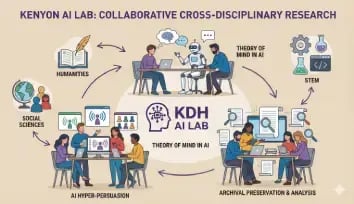
How Kenyon College Is Rewriting the Rules for AI in the Humanities
Why Kenyon’s AI Lab Matters for the Humanities At a moment when headlines question the value of liberal arts degrees, Kenyon College is running a...
The signal across AI-only rivals, AI-native work environments, and vertical acceleration is consistent: AI advantage is shifting from “helping humans do tasks” to “rewriting how the business competes.” The winners won’t be the companies with the most pilots—they’ll be the ones that redesign defensibility, operating cadence, and domain depth so they can learn and iterate faster than AI-native entrants.
Key takeaways
Assume AI-native entrants will out-iterate you unless you redesign your operating rhythm (build–measure–learn, weekly not annual).
Defensibility beats adoption: ask whether your business model survives when rebuilt AI-first.
Domain-intimate systems win: your edge comes from proprietary data + protocols + connectors, not generic assistants.
Real-time grounding is the next frontier: link AI to operational systems, live feeds, geospatial context, and physical workflows.
Workflow redesign is a strategy: decision rights, memory, context continuity, and team structure become competitive assets.
Origami is not about folding paper. It’s about committing to a strategy and structure as well as executing the folds needed to build a beautiful artifact from a simple, flat piece of paper. AI will make many firms origami themselves to compete in the fast-moving, competitive market we are entering.
AI Brings Us All Back to The Drawing Board

At my firm, we do a news show 5 days a week, rating AI case studies, products, and research: Essential, Important, or Optional. A popular narrative around generative AI has focused on productivity gains, smarter assistants, and faster workflows. These benefits are clear when well implemented. But the reality facing CEOs today is far deeper : a new class of rivals is emerging—AI-native competitors, operating with architectures, business models, and strategic rhythms that outpace incumbents. In this moment, AI is not simply a productivity lever—it has become a competitive frontier.
In a recent briefing, Boston Consulting Group argues that traditional enterprises must prepare for “AI-only rivals” that bypass the organizational drag of legacy systems, human hierarchies, and incremental change. BCG, meanwhile, on the consumer productivity side, ChatGPT Atlas from OpenAI demonstrates how the browser itself is being re-imagined around AI memory, context, and task automation—shifting the endpoint of work rather than simply layering AI on top. OpenAI In parallel, the healthcare and life sciences sectors show how domain-specific AI efforts are accelerating with real business stakes: the healthcare industry is moving at 2.2× the pace of the broader economy in AI adoption. Menlo Ventures. In the life sciences, Claude by Anthropic is evolving from a general-purpose model to a specialist research partner deeply integrated into scientific workflows. Anthropic Finally, under-the-radar signals like the integration of live mapping data into AI apps (via Gemini from Google) show how AI is embedding into physical-world operations, not just textual or conversational flows. Venturebeat
Taken together, these strands point in the same direction: CEOs and senior leaders must shift from an “AI productivity” mindset to an “AI competition model” mindset. They need to think not just how AI helps their people, but how AI redefines their business, their rivals and their time horizon.
Our analysis outlines a clear scenario: that future competitors may launch with AI-first architectures, fewer legacy constraints and more agile business models. This is not hypothetical. Many start-ups, ecosystems and digital-native firms already operate on that basis. For incumbents, the danger is not just disruptive entrants—it’s entrants built around generative AI, data hyper-scale, and constant iteration.
These rivals can design systems that learn, adapt and evolve without the human delays, organizational inertia and technical debt of traditional firms. Thus the strategic challenge isn’t simply “we must adopt AI” but “we must defend or extend our business model when rivals build from scratch differently.”
For senior executives, the implication is unsettling: even if you adopt AI rapidly, you may still be defending a legacy model while someone else builds a new one from day 1. The urgent task is to assess whether your model remains defensible in a world of AI-native competition—then decide whether to evolve or reinvent.
The release of ChatGPT Atlas underscores a deeper shift: the “browser”—the platform where so much work gets done—is being reconstructed around AI memory, context, and workflow automation. Rather than simply using AI as a chat tool, this is about embedding AI into the fabric of work: tab by tab, document by document, task by task. OpenAI
What does this mean for organizations?
For organizational advantage, this means investments in AI should not stop at “use this platform” but interrogate work design, interaction flows and cognitive architecture.
In the healthcare sector, Menlo Ventures reports that adoption of domain-specific AI tools has leapt to 22% across healthcare orgs—seven-fold over 2024. Menlo Ventures Providers, payers and life sciences are deploying AI to slash documentation burdens, reduce clinician burnout, expedite R&D, and shift large-scale processes into software-driven modes. What was once seen as “slow to digitize” is now moving fast.
In life sciences, Claude for Life Sciences signals something deeper: the evolution of large-language-model tools into domain-specific research engines with connectors into lab systems, bioinformatics data, and regulatory workflows. Anthropic
What these verticals teach us for enterprise-scale transformation:
Thus for any organization—whether manufacturing, consumer goods, services—the question is: are you building a generic AI accelerant or a domain-intimate AI engine tailored to your business logic, protocols, and data flows?
The integration of live geospatial data into Gemini-powered AI apps reveals another dimension: AI is moving from static text and conversation into real-time, context-aware, location-aware operations. Venturebeat
What does this imply for firms?
For senior executives, the inference is clear: if your business has physical-world touchpoints, simply applying the same horizontal AI stack as everyone else is insufficient. You must ask how AI interlinks with real-time operational systems, sensors, geospatial data, supply-chain flows.
What should a CEO or senior executive take away from this convergence of trends? I propose five imperatives:
1. Re-frame from “AI productivity” to “AI competitive model”.
Too many companies treat AI as a cost-reduction or task-acceleration tool. That’s necessary but not sufficient. The strategic ambition must be: How can AI reshape our business model, forge new rivals, or defend against them?
2. Evaluate your defensibility in an AI-native landscape.
Ask: Could a start-up, built with generative AI, domain data and operational agility, challenge our value-chain position? If yes, then transformation isn’t “nice to have” — it’s existential.
3. Invest in domain-specific AI engines, not just horizontal platforms.
General assistants are useful, but the market is moving toward domain-intimate models (e.g., life-sciences AI, rich data connectors, industry-specific workflows). Your edge will come from domain data, institutional expertise, flows and protocols.
4. Align AI to operations, context and real-world flows.
Whether it’s field operations, logistics, supply chains, retail networks or servicing, the next wave of value lies where AI is embedded in real-time systems, not just used in discrete tasks. Map-grounding, sensor integration, real-time feeds matter.
5. Redesign workflows and organizational architecture around AI.
If the endpoint of work is shifting (as ChatGPT Atlas suggests), then organizations must redesign workflows: roles, teaming, decision-rights, data pipelines, and governance. AI isn’t just another tool to plug in—it changes how work gets done.
I did a TEDx talk last year on a concept I’m calling “Socrates at Scale” which explored the implications of having an organization that learns so much better, as much as two standard deviations better than the competition. If you can learn that much better and faster, unless you are teaching your folks silly things – you will win in time.
In the AI era, the mindset of learning and fast application rules: we must question not just which tool but which business logic, which workflow, which competitive arena AI enables – and can we learn the new skills faster than anyone.
In practical terms ask:
The logic of waiting is undone. The data from healthcare and vertical AI adoption tell us: change is happening fast. Whether in scientific R&D, operational flows or user interfaces, the standard for advantage is shifting. CEOs and senior leaders cannot treat AI as a five-year item. It’s a horizon-shifting force.
In moving from “productivity” to “competition”, the transformation timeline shortens—what used to be “pilot, assess, scale in 18 months” becomes “pilot, scale, iteratively disrupt within the year.” The consequence: firms that succeed will have built AI-native rhythms—cycles of sensing, learning, building, scaling—rather than waiting for annual budget rounds.
Ask: What is our AI-native version of ourselves? What would a rival look like if they built from scratch in our industry with no legacy? How do we re-architect work, operations, and strategy around AI? —these become central.
The transition ahead is not just about being more efficient—it’s about being structurally different. The future of advantage is not just “digital plus AI” but AI-first business logic at scale. It’s time to scale up your folding skills or you may be the wrong shape to compete!
Onward,
Paul
.
Why Kenyon’s AI Lab Matters for the Humanities At a moment when headlines question the value of liberal arts degrees, Kenyon College is running a...
When we talk about Generative AI (GenAI), innovation often takes center stage. In 2024, we were overwhelmed with the barrage of new products and...
Walmart announced a partnership with OpenAI that enables customers to shop Walmart through ChatGPT using Instant Checkout. This pushes retail...
Trusted by companies and vendors around the globe - we help you cut through the noise and stay informed so you can unlock the transformative power of GenAI .
Join us at this year's Generative AI World! Hear from enterprise AI leaders who are achieving meaningful ROI with their GenAI initiatives and connect in-person with the GAI Insights members community including C-suite executives, enterprise AI leaders, investors, and startup founders around the world