
 GAI Insights Team
The Power of No-Code LLMs: Democratizing AI for Businesses of All Sizes
The Power of No-Code LLMs: Democratizing AI for Businesses of All Sizes
In the rapidly evolving landscape of artificial intelligence, the emergence...

PwC is likely to hire fewer college graduates over the next few years because AI tools let smaller teams produce the same (or more) client output. The near-term effect is usually slower campus hiring and “do more with fewer people,” not the end of consulting.
Key takeaways:
AI shifts a lot of junior work to AI-first drafts + human review.
Firms can reduce hiring by improving output per employee and avoiding headcount growth.
The most exposed tasks are repeatable research, slide production, and first-pass analysis.
Colleges and students feel pressure if they don’t build AI workflow + verification skills.
Leaders should run small pilots, set safe-use rules, and track time-to-deliverable + error/rework rate.
The winners won’t be “AI-only”—they’ll be teams that pair AI speed with strong human judgment.
Like most consulting firms, PwC is rapidly adopting AI to increase employee productivity and deliver greater customer value. Smaller teams of humans, supported by increasingly larger teams of AI software (or AI agents), now perform work that was handled solely by humans just a few years ago. As a result, PwC and other consulting firms require fewer employees. These are not entry-level, fast-food jobs; starting salaries for graduates heading to McKinsey, PwC, and other consulting firms range from $100,000 to $145,000.
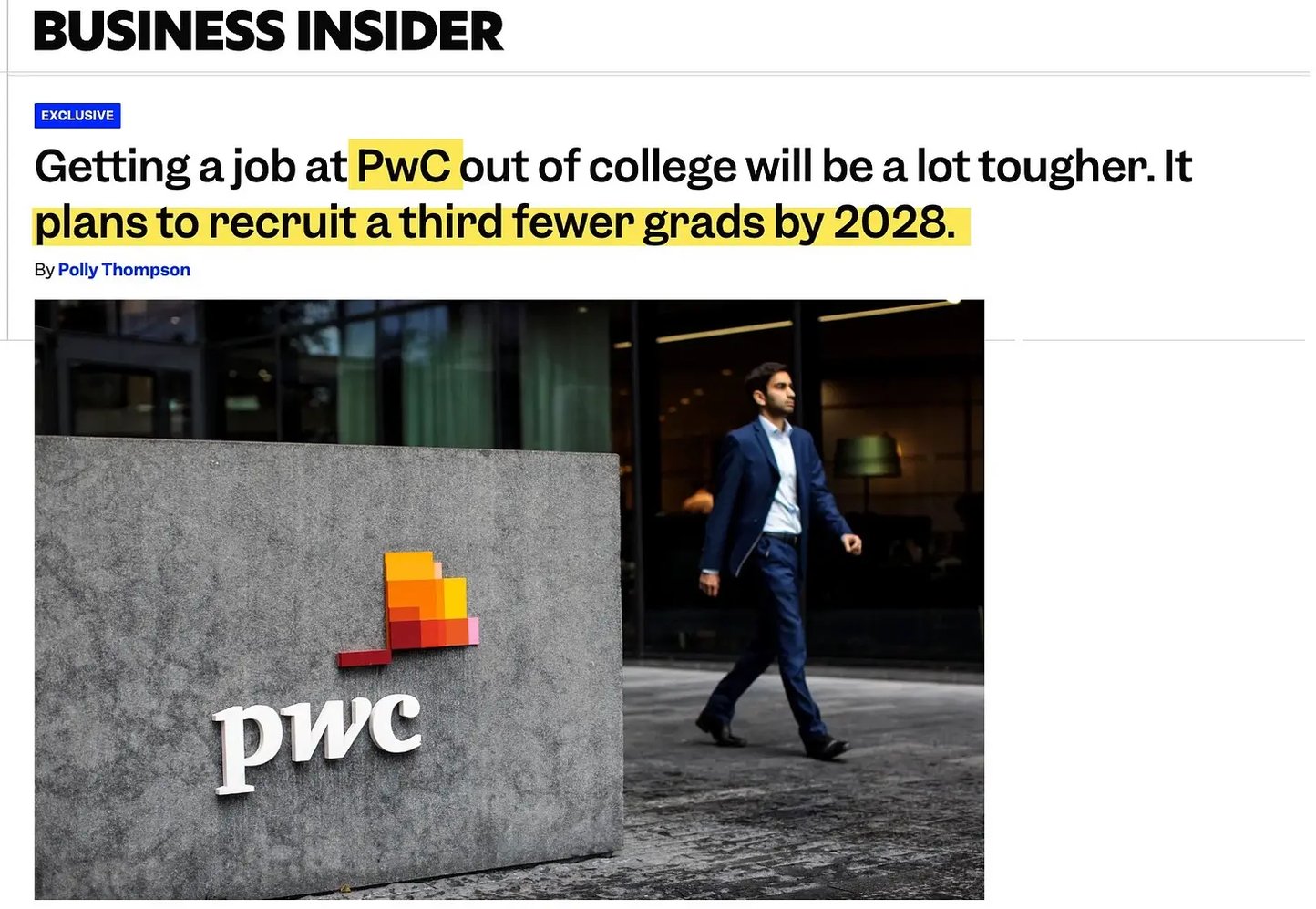
This shift will have a major impact on liberal arts colleges and Ivy universities that charge $50,000 to $80,000 per year in tuition and see a large number of their graduates enter consulting or finance. I expect that many of the top 50 liberal arts colleges will face 20–30% unemployment rates among graduates within a few years, primarily because the colleges are not adapting quickly enough.

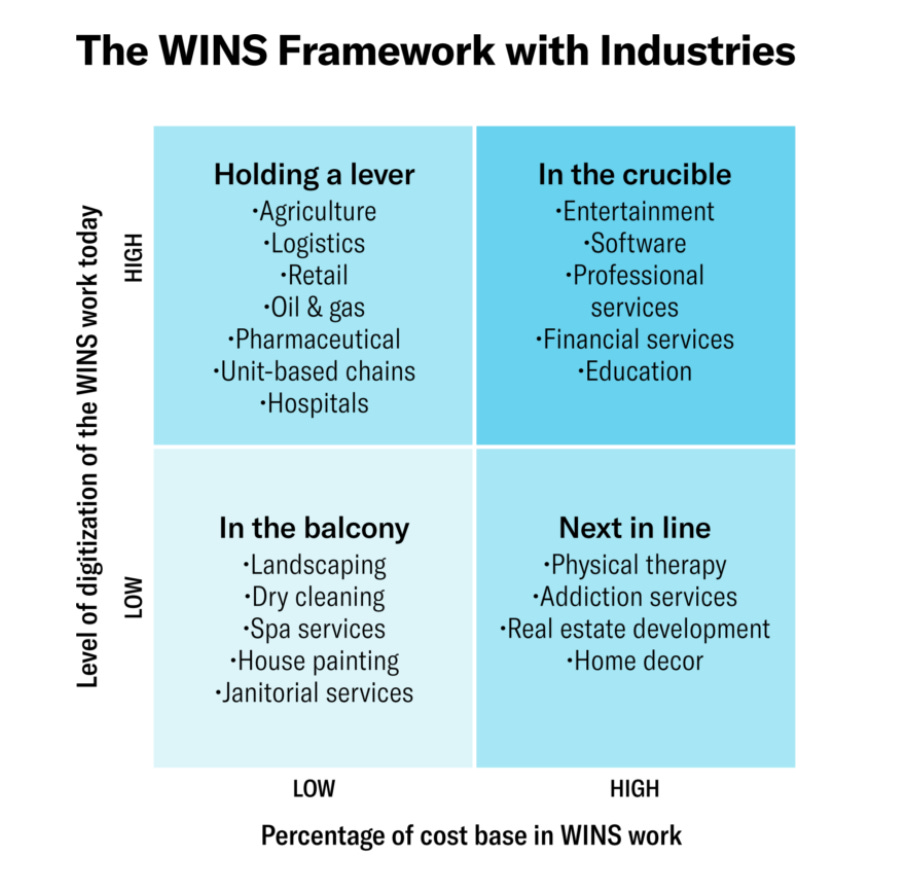
Consulting is one of several industries “in the crucible” according to our WINS framework. Published in Harvard Business Review in 2023, our WINS framework highlights which industries and types of firms are most affected by GenAI and it remains highly useful.
WINS stands for Words, Images, Numbers, and Sounds, providing a concrete example of knowledge work. If the majority of your cost base consists of humans manipulating words, images, numbers, and sounds, then your company is “in the crucible,” which we define as facing 10–30% revenue and profit impact in the next two years due to GenAI.

At a TEDx Boston talk, I outlined six things companies and employees need to do to adapt:
Don’t be an ostrich—face reality.
Lead from the top.
Spend one to two hours per quarter on learning and alignment with the Board and Leadership Team.
Develop a new mindset around team AI augmentation.
Stay current with “eyes bleed” case studies and benchmarking.
Create “learning vibrancy” within your company.
PwC is reducing campus hiring because AI tools now automate large portions of research, drafting, and analysis that junior teams used to handle. Smaller human teams can now deliver the same output with AI-first workflows.
AI excels at repeatable, pattern-based work such as research synthesis, slide drafting, summarization, data extraction, and first-pass financial or market analysis. These activities once required large analyst teams.
No. AI reduces hiring growth, not the need for consultants. Jobs shift toward client advisory, judgment-driven decision-making, verification, and managing AI-augmented workflows rather than producing raw analysis.
Graduates without AI skills may face higher unemployment as firms prefer fewer but more AI-proficient hires. Students must show they can use AI to accelerate research, create drafts, and verify outputs accurately.
They need strong prompt design, AI-assisted analysis, verification techniques, critical reasoning, and the ability to blend AI output with business judgment. Portfolio evidence of AI-augmented work is becoming essential.
Firms should run AI augmentation pilots, create safe-use guidelines, measure productivity gains, and train teams in AI-first workflows. Hiring should prioritize judgment, client skills, and the ability to supervise AI tools
Onward,
Paul
.
In the rapidly evolving landscape of artificial intelligence, the emergence...

Some enterprises are standardizing on one secure employee chatbot, and a subset are switching from Microsoft Copilot Chat to OpenAI ChatGPT...

As enterprises accelerate their adoption of Generative AI (GenAI), a key question emerges: should they rely on cloud-based AI inference, or should...