
 GAI Insights Team
The Only AI Strategy Metric That Matters: Revenue per Employee
Why Revenue per Employee Beats AI Buzzwords
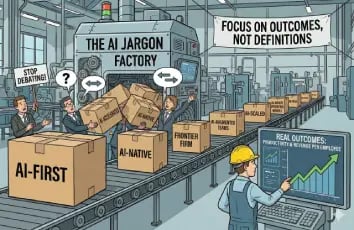
Consultants can argue endlessly about whether a company is “AI-first,” “AI-native,” or “AI-accelerated.”...

AI is becoming the defining strategic resource of the 21st century—playing the role that steel did in the 19th century and oil did in the 20th. No nation, not even the U.S. or China, fully controls every layer of the AI stack, yet each must decide how to secure energy, hardware, data, models, and talent without surrendering autonomy to a single foreign vendor or bloc. This article offers a practical 5-layer framework for Sovereign AI and shows how countries can avoid lock-in, navigate between the U.S. and Chinese stacks, and pursue a “Third Way” that preserves dignity and self-determination.
Key takeaways:
AI is now a strategic resource on par with steel and oil—core to national power, economic security, and cultural identity.
No country can own the full stack alone; even the U.S. and China are interdependent across chips, energy, capital, and talent.
The 5-layer Sovereign AI Stack (Energy, Hardware, Data, Models, Talent) provides a simple map for assessing national strengths and gaps.
Optionality and switchability are hidden sources of power—nations that avoid single-vendor lock-in retain leverage and control.
The world is consolidating around a U.S. stack and a Chinese stack, but an increasing number of countries are building a “Third Way” hybrid strategy.
Sovereignty is not isolation; it’s the ability to tap global innovation while still controlling the intelligence that runs your nation.
“Every country needs its own sovereign AI – to produce intelligence rather than import it.” – Jensen Huang, CEO NVIDIA, World Government Summit 2024
I wholeheartedly agree with Jensen on this point. Furthermore, every business leader needs to understand the AI strategy of the countries they operate in. In every era, nations have rallied around strategic resources that determine their fate. In the 19th century, it was steel. In the 20th, oil. In the 21st century, it is artificial intelligence. We can see this awakening in the billions and billions of dollars of announcements in AI infrastructure alone – Europe 20B+ Euros, Saudi Arabia $100B+, US $1-2T+, just to name a few. AI is not just a technology, it is a foundational component of national power, economic security, and in time – cultural identity.
In principle, every country would like to control their entire AI destiny – top to bottom. The challenge is that no country – not even the US and China – are fully independent in their supply of AI. Some have the models, but not the chip manufacturing capability. Others have a paucity of talent. Yet others don’t have the layer of venture capital needed to innovate and grow. The two clear giants in the space are the US and China because they are strong – directly or indirectly in all five layers needed for AI.
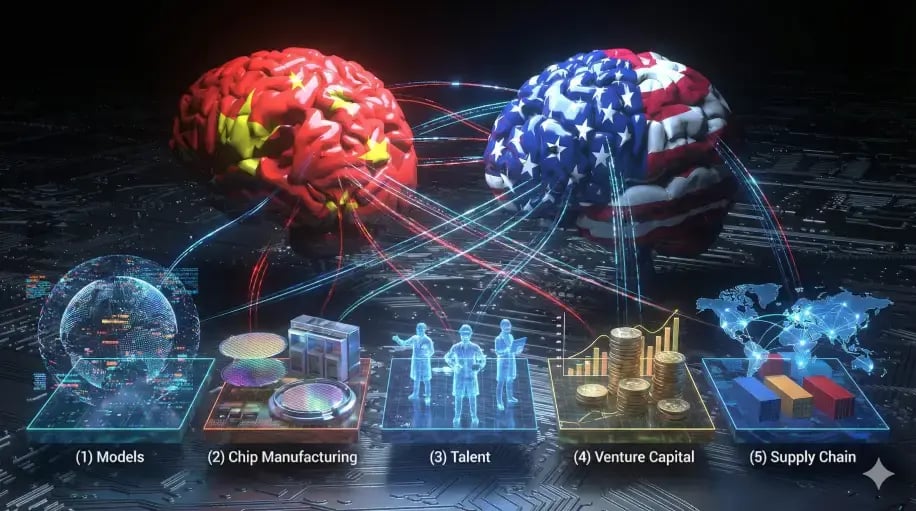
Given the existential risk that AI creates in warfare, we can confidently predict that these two nations will continue their emerging AI cold war. The good news for other nations is that the AI Cold War, creates many complementary dividends for other nation states. For example, in the Open Source models, China takes 9 out of the ten top spots for quality. OpenAI’s gpt-oss-120B (high) model, slotting in at number 3, is the only non-Chinese competitor. In the proprietary models the roles are reversed where China has only one winner in the top 10 to date. This plethora of open source models provided by the Chinese enables many nations to have a credible alternative to the US/European models. And, given their open source nature, they can (if managed well) be much cheaper to innovate and scale with.
More firms are creating their own hardware – both in China and the US. NVIDIA continues to dominate the market both for the highest end hardware and their CUDA software stack. In time, new alternatives from Intel, Qualcomm, AMD, Huawei, Alibaba, Baidu and others will create more competition at the hardware layer. Also, some nation states, like Saudi Arabia want to export AI using their very cheap energy as one competitive advantage. The good news is that every layer of capability is developing a robust set of competitors, which is great news for even the smallest nation if they play their cards right.
In an effort to help navigate this complex domain of Sovereign AI, we created a purposefully simple model – with five layers: Energy, Hardware, Data, Models, Talent. (See Figure 1 below.)
Figure 1: 5 Layer Sovereign AI Stack

Let me explain each of the dimensions more fully below.
Modern AI is energy-intensive. Data-center energy usage is projected to rise by over 100 TWh per year—roughly equivalent to the electricity consumption of the Netherlands (de Vries, 2024). Without cheap, abundant, and stable power, AI ambitions collapse. Emotionally, this speaks to a primal national fear: the fear of being left behind because of a bottleneck as old as civilization—energy.
NVIDIA holds a commanding lead in global high-end AI chips, but the competition is heating up from Chinese producers as well as American ones. One of the most interesting is Qualcomm which is creating AI capacity at the network’s edge – especially in our phones. These will all provide AI supply to the world at better and better prices.
Data Sovereignty is a strategic concern. For example, the UAE is ambitiously collecting DNA for their entire nation - a very valuable data stream. As of this month, they have already collected DNA from over 750,000 Emirati’s. The plan is to use this data as part of their plan for an AI future.
The ability to build, train, improve and operate models will be critical. There are more and more small, and medium models. Algorithmic innovation is helping DeepSeek and other train frontier models for a tenth or less of the cost. There are many new entry points for countries with small resources to either use existing open source models, or even train new small and medium size models.
Talent is perhaps the most scarce resource of all. China and the USA have over 60% of the talent in AI. There is no doubt that the best talent in the world usually flows to dynamic clusters of innovation like Silicon Valley, Toronto, or Beijing – and the great firms located there too. Yet, the beauty of AI is that it can teach humans how to build it. We’ve never had a technology that could by itself teach the world how to use it. This recursive amplifier will speed adoption in new geographies. In addition, with AI, very small groups of people – especially technologists – can do the work of many. But any nation state that wants to build this must focus on a clear talent strategy.
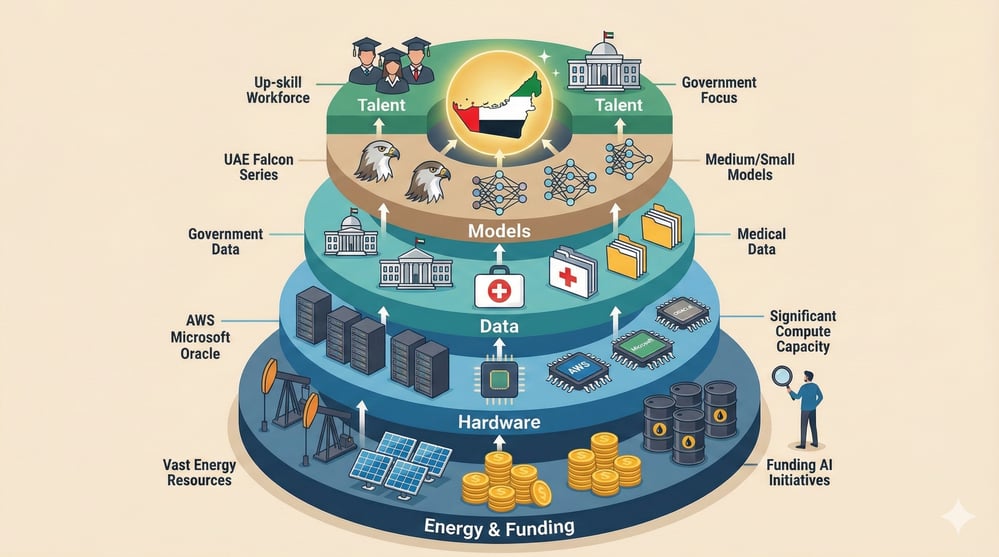
We can look at any country through this lens. For example, the UAE has a number of initiatives on each layer of the Sovereign AI Stack. Their vast energy resources easily fund their AI initiatives. At the hardware level they have announced deals with AWS, Microsoft and Oracle to build significant compute capacity for local use and as a service to the region. For data there is a treasure trove of government data, medical data (as mentioned above) and other sources. For models, the UAE has its own Falcon series of models that compete well in the medium and small model categories, and they are working to up-skill their workforce – especially in the government.
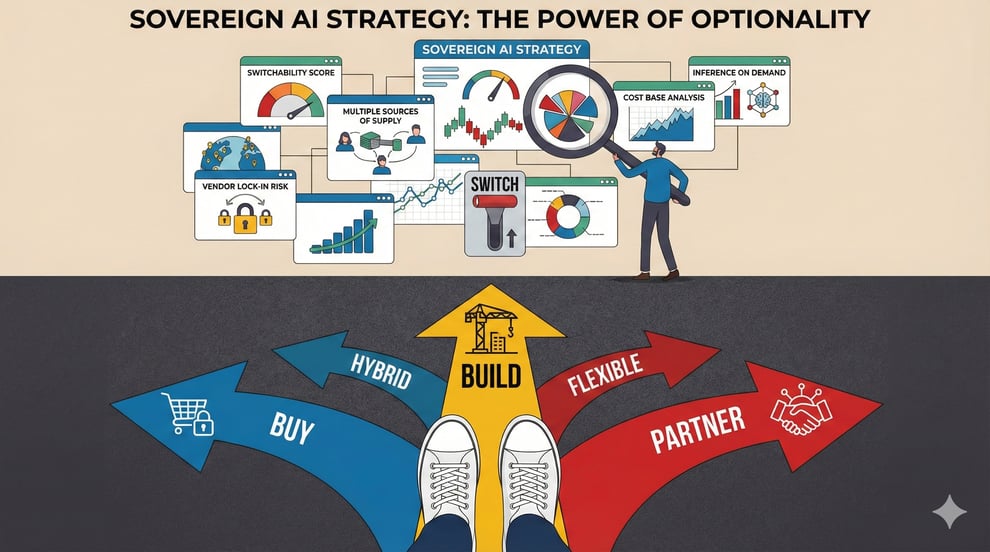
After considering the current state of affairs for a nation across the levels of the Sovereign AI model, any forward looking strategy should be considering if they should buy, build or partner to fill out a layer. And in the execution of the strategy, switchability is a key dimension. As SaaS built out and more and more firms became dependent on a few mega cloud service providers, they began to exercise their market power and raise prices. Many firms complained about the high cost of cloud services. As we enter the hybrid age, where people only firms will be competing with hybrid firms – with a strategic blend of human and machine intelligence, AI will become more of the cost base of all firms. If countries allow themselves to be locked into one vendor, it erodes decision making power and negotiating leverage.
In creating the country level solution, switchability and multiple sources of supply are essential. There are firms, usually focused providers with deep technical understanding and experienced teams, that can help keep the sovereign AI strategy from lock-in. There are also firms who are willing to provide inference on demand and a fixed cost solution to AI as well as absorbing any costs of switching models. The sovereign AI strategist must be willing to look for these focused providers because the larger firms and hyper scalers tend to want the customer to lock into their solution, to the exclusion of all others. Nations that retain optionality can redirect workloads, retrain models locally, or shift suppliers with minimal friction.
The world is rapidly organizing itself around two dominant technological spheres: the U.S. AI stack and the Chinese AI stack. Much like the geopolitical alignments of the Cold War, these AI ecosystems are becoming gravitational centers that pull nations into their orbits. But unlike the 20th century, alignment today is driven as much by algorithms, chips, and data governance as by military blocs or ideological persuasion.
The U.S. ecosystem offers unmatched access to the world’s leading AI frontier: companies like OpenAI, Google, Anthropic, and NVIDIA continue to set the pace for global innovation. With the deepest venture capital markets, a concentration of top AI talent, and hyper-scale cloud platforms that power most of the world’s enterprise AI. The U.S. stack is the closest thing to a turnkey solution for any nation wanting to accelerate quickly.
Yet with technological power comes geopolitical entanglement. Nations aligned with the U.S. stack face a persistent unease: How vulnerable are we to U.S. foreign policy shifts or export controls? Recent GPU licensing restrictions and cloud governance debates show how swiftly U.S. policy can change. For many countries, the emotional response is a mix of admiration and anxiety. They want the innovation, but not the dependency. They want the performance, but not the political exposure. In a world where AI increasingly runs everything from healthcare to national security systems, the fear of becoming collateral damage in geopolitical crosswinds is real—and growing.
China provides a powerful alternative. Companies such as Alibaba, Tencent, and Baidu offer competitive LLMs, mature cloud infrastructure, and increasingly strong hardware pathways. For nations seeking rapid digitization without Western dependency, the Chinese stack promises speed, affordability, and seamless integration.
But the risks are equally significant. China’s model comes with heightened concerns about surveillance, data access, and ideological alignment. The emotional tension here is centered on trust: Can a nation entrust its data, models, and critical infrastructure to a system whose governance norms differ radically from its own? For many governments, the answer is complicated—China offers capability without Western strings, but perhaps with strings of its own.
Caught between these two poles, a growing number of nations are forging a Third Way. Instead of fully aligning with Washington or Beijing, countries like France, the UAE, and Singapore are building hybrid AI sovereignty strategies. They buy compute and tools from global leaders, build domestic AI models and datasets, partner selectively for specialized capabilities, and—most importantly—preserve autonomy.
This path requires discipline. It demands careful architectural planning, regulatory foresight, and significant investment. But the reward is compelling: dignity without dependency. Nations retain the ability to innovate on their own terms while tapping into global advances.
France has embraced a “partner and build” strategy. It leverages the EU’s regulatory strength—especially the AI Act—to safeguard European data and set global norms. At the same time, France is cultivating domestic champions such as Mistral AI, positioned as an open-source counterweight to American tech giants. Emotionally, France’s approach is a statement of European identity: a belief that Europe must shape AI rather than simply consume it.
As this case illustrates a broader truth: in a multipolar AI world, sovereignty is not about choosing sides—it’s about choosing a strategy.
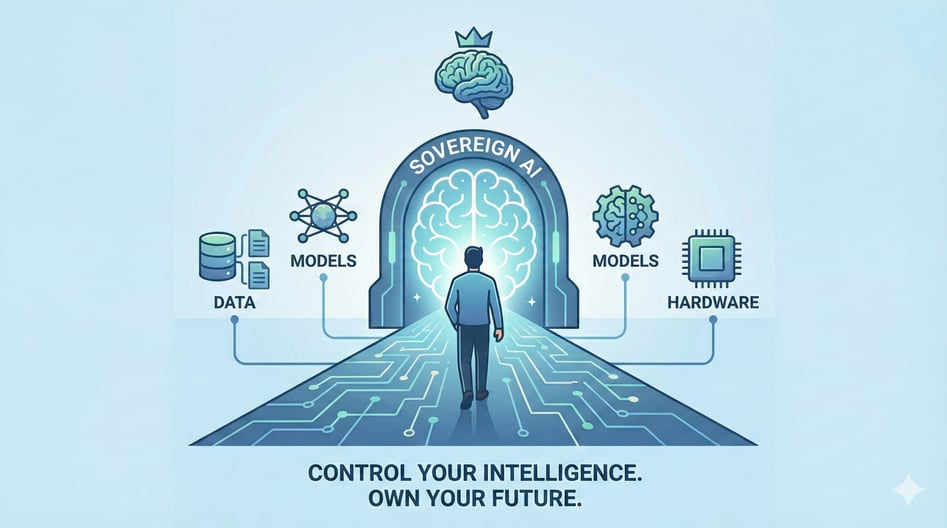
The rise of Sovereign AI marks a defining moment in global history. The nations that thrive will not be those seeking total independence—an impossibility—but those investing strategically across the Sovereign AI spectrum:
This is the new national mandate. Sovereignty is no longer about borders—it is about who controls the intelligence that runs the nation.
The window to act is narrowing, but for nations that embrace the Sovereign AI Spectrum today, the reward is historic: the ability to determine their technological fate on their own terms.
Onward,
Paul
.
Consultants can argue endlessly about whether a company is “AI-first,” “AI-native,” or “AI-accelerated.”...
The signal across AI-only rivals, AI-native work environments, and vertical acceleration is...
Every workday, our AI analysts review GenAI news, labeling interest items Essential, Important, or Optional. Here are some of the top items that made...
.png?width=427&height=240&name=unnamed%20(2).png)