
 GAI Insights Team
You're Not Benchmarking Technology Anymore —You're Benchmarking Intelligence
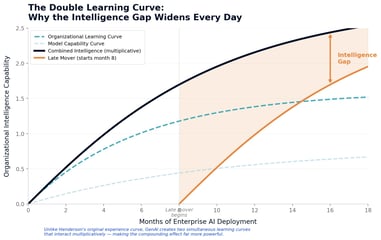
And the difference is a learning curve that compounds every day you wait
In the 1960s, Bruce Henderson at the Boston Consulting Group made an...

Why the companies pulling ahead right now are building advantages their competitors may never close
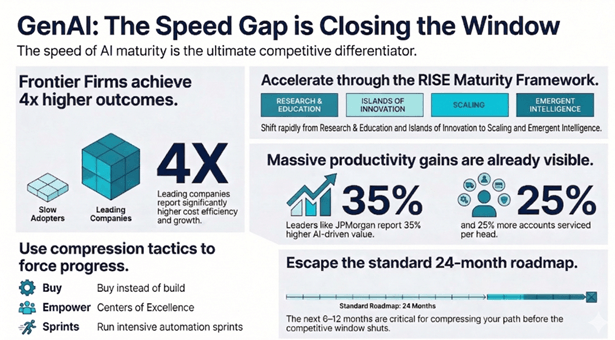
Here is the uncomfortable truth about your GenAI roadmap: you probably built it assuming your competitors would move at roughly the same speed you are. They are not. In every major industry — banking, retail, staffing, healthcare, legal — we are watching companies in the same market, facing the same conditions, open up gaps so wide that the slower mover may spend years trying to close them. The question for every senior executive right now is not whether to transform. It is whether you are transforming fast enough relative to the company in your industry that is moving fastest.
At GAI Insights, we use the RISE framework to help organizations understand where they are in their AI maturity journey: Research & Education, Islands of Innovation, Scaling & Orchestration, and Emergent Intelligence. In our experience, most enterprises still resemble the first two stages — a view that aligns with outside surveys showing that the majority of organizations have not yet scaled AI enterprise-wide. The problem is that the timeline to move through those stages is not fixed. It depends on your industry, your competitive position, and — critically — the speed at which the fastest mover in your market is compounding their advantage.
The evidence is no longer theoretical. Consider three examples from the last twelve months.
Banking: JPMorgan Chase vs. Citigroup. JPMorgan deployed its LLM Suite to more than 200,000 employees and is already reporting hard outcomes — a 35% increase in AI/ML-driven value, 25% more accounts serviced per ops headcount, servicing calls down nearly 30%, processing costs down 15%. Citigroup spent $11.8 billion on technology in 2024 and launched AI platforms for 143,000 colleagues — but its own leadership acknowledged there is still "a lot more work to do" on data infrastructure. Same industry, same regulatory environment. One is publishing productivity outcomes. The other is still completing the modernization that makes those outcomes possible.
Retail: Walmart vs. Target. Walmart used multiple LLMs to create or improve more than 850 million pieces of catalog data — work that would have required nearly 100 times its current headcount without GenAI. Separately, it announced AI-powered tools for 1.5 million U.S. associates, while its internal GenAI assistant had previously been expanded to 11 countries. Target deployed a GenAI chatbot to nearly 2,000 stores and launched a shopping experience inside ChatGPT — real work, but fewer quantified outcomes and narrower scope. Walmart is building AI into its operating system. Target is deploying AI tools.
Staffing: Adecco vs. ManpowerGroup. Adecco completed its first agentic AI implementation at scale, and 57% of candidate conversations now happen outside office hours. By March 2026, it committed to having more than 50% of revenues powered by agentic AI by year-end. ManpowerGroup partnered with Carv in July 2025 to embed agentic AI in recruiter workflows — but the public evidence is still partnership-and-integration language, not production deployment and revenue targets.
These are not stories about good companies and bad companies. Citigroup, Target, and ManpowerGroup are all making real investments. The gap is about speed — specifically, the speed at which each company is moving through the stages that separate early experimentation from scaled, compounding value.
If you are a senior executive looking at your own AI roadmap, the critical question is: are you on a standard timeline or a compressed one? And does your competitive reality demand the compressed path?
A typical path through RISE looks something like this: several months of education and experimentation, followed by a period of building islands of innovation across departments, then a longer push to orchestrate those islands into connected systems, and eventually — if everything goes well — emergent intelligence where AI is generating insights and capabilities nobody designed explicitly. That is a reasonable timeline if your competitors are moving at the same pace.
But the companies in the examples above are not following the standard path. They are compressing it. And the techniques they are using are not mysterious — they are organizational choices that any enterprise can make if the urgency is clear.
Compression is not about cutting corners. It is about making structural decisions that accelerate the tipping point from pre-AI to post-AI operations in each part of your business. Think of it the way you would think about quality transformation in manufacturing: the goal is not to inspect quality in at the end — it is to get every operational unit past the tipping point where the new way of working becomes the default.
Buy the foundation, build on top. Walmart used multiple external LLMs through Azure OpenAI Service for its catalog transformation, but it also develops proprietary AI capabilities through its Element platform. The point is not to outsource everything — it is to avoid rebuilding commoditized intelligence from scratch when speed matters. Buy the foundation, then apply it to proprietary workflows at scale. That compressed what could have been years of R&D into months of deployment.
Stand up a center of excellence — and give it teeth. The companies that are moving fastest have not sprinkled AI across the organization and hoped for organic adoption. They created dedicated teams — JPMorgan with its AI/ML organization, DHL with its dedicated Generative AI team, BNY Mellon with its AI Hub — and gave them the mandate and resources to drive deployment across business units. A center of excellence without budget authority and operational reach is just a research lab.
Use hackathons and intensive sprints to force tipping points. BNY says 99% of its 50,000 employees have been trained on its AI platform Eliza and that 134 digital employees are now live. Media reports add that these digital workers have logins and human managers — they are treated as members of the team, not background automation. That did not happen through a gradual awareness campaign. It happened through intensive, compressed programs — including multi-day AI bootcamps for non-engineers — designed to change behavior in days, not quarters.
Make a structural move that forces the organization forward. Sometimes the compression technique is a bold organizational decision. Walmart moved its stock listing from the NYSE to the Nasdaq — a signal to the market and to its own people that it sees itself as a technology company. Adecco set a public target of 50% of revenues powered by agentic AI by the end of 2026. These are not just communications strategies. They are commitment devices that make it harder for the organization to retreat to the comfortable pace.
Every senior executive reading this can place themselves and their competitors on the RISE model. The question is not where you are — it is how fast the gap between you and the fastest mover in your industry is growing.
Microsoft's 2025 Work Trend Index coined the term "Frontier Firms" — organizations that have moved beyond AI experimentation and are rebuilding around it. In a subsequent analysis, Microsoft reported that these firms outperform slow adopters by roughly four times on business outcomes including cost efficiency, top-line growth, and customer experience. The compounding effect is the part that should keep executives up at night: AI capabilities generate data that improves AI performance, which enables new use cases, which generates more data. The companies that move through RISE fastest do not just get a head start — they build a learning curve that accelerates with every cycle.
If your industry's fastest mover is already at Scaling & Orchestration while you are still in Islands of Innovation, a standard-speed roadmap will not close the gap. It will widen it. The next 6–12 months are not about planning your AI strategy. They are about compressing your path through RISE before the window closes.
GAI Insights helps enterprise AI leaders move from strategy to execution. Learn more at gaiinsights.com.
And the difference is a learning curve that compounds every day you wait
In the 1960s, Bruce Henderson at the Boston Consulting Group made an...
Most enterprises chose their AI ops platform the same way they chose their pilot vendor: based on what was fastest to deploy. That made sense at...
Sales, Sales, Sales.
Sales productivity is...