
 GAI Insights Team
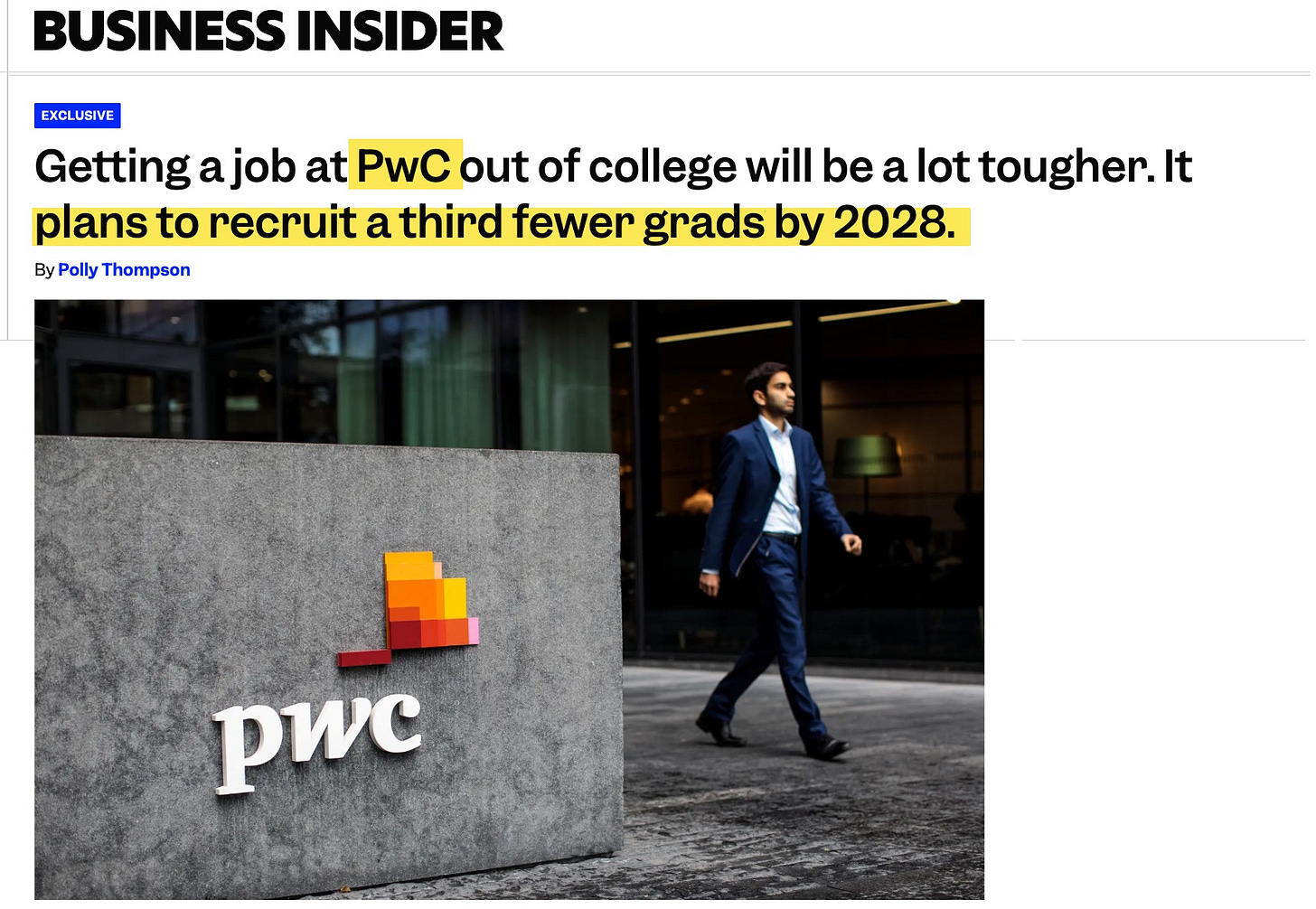
PwC To Hire 1/3 Less College Grads The Next Few Years
PwC is likely to hire fewer college graduates over the next few years because AI tools let smaller teams produce the same (or more) client output....

AI agents aren’t replacing high-paid professionals overnight—they’re rebuilding the workflow around them. The near-term impact is cycle-time compression, headcount avoidance, and higher output per employee as planning + execution moves from “humans coordinating tools” to “agents coordinating systems.” The long-term impact is bigger: organizations that encode how their best people work will scale expertise like a factory scales production.
Key takeaways:
In the early 1900s, Henry Ford did not invent the automobile. He invented the factory floor. Productivity did not rise because workers tried harder; it rose because work was decomposed, standardized, and reassembled around specialized machines operating as a system.
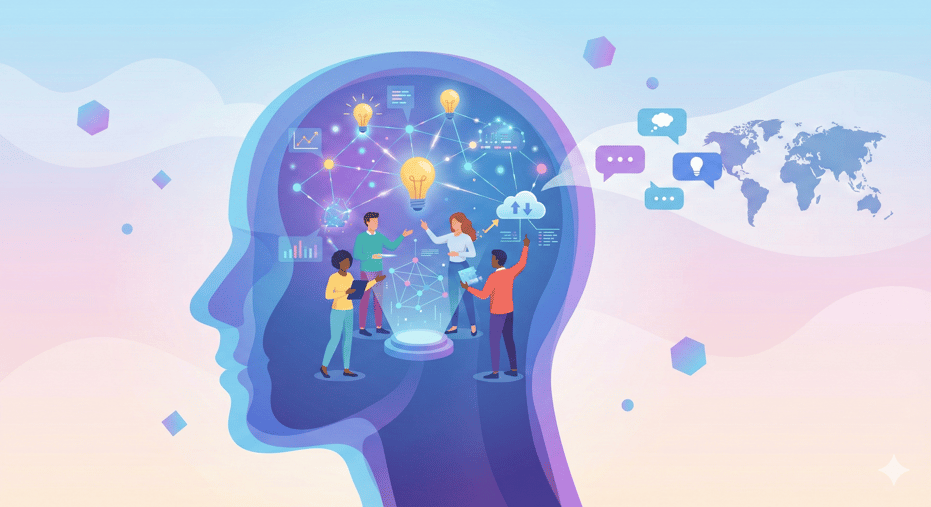
Today, knowledge work is finally getting its own factory floor—but it is invisible.
Instead of steel and conveyor belts, this new factory is made of AI agents: systems that plan, execute, and coordinate work across digital workflows. This is not a story about tools. It is a story about the redesign of work itself. The leaders who understand this distinction will create durable organizational advantage. Those who do not will merely automate yesterday’s processes a little faster.
The critical shift for CEOs to grasp is that major platforms—ChatGPT, Microsoft Copilot, Claude, and others—have radically lowered the cost and difficulty of automating knowledge work. What once required teams of engineers and months of specification can now be expressed in natural language and executed directly. That change is structural, not incremental.
Three forces are driving this transformation.
For decades, software was expensive to build and difficult to change. As a result, well-run IT organizations enforced strict specifications, limited customization, and standardized workflows. Variety was treated as inefficiency.
AI agents invert that logic. When software can be created, modified, and extended through natural language, the cost of variety collapses. The distance between intent and executable code shrinks dramatically. Workers no longer need to translate their needs into formal requirements and then into programming languages. They can simply describe what they want.
This does not eliminate the role of IT—but it changes it. Early-stage automation no longer requires centralized development. Individual employees can build highly specific productivity tools for their own work, and only later, if those tools prove valuable, do they need to be hardened, governed, and scaled. Control moves downstream; innovation moves upstream.
High-value knowledge work has always been variable. The details matter. Judgment matters. Context matters. That is why senior professionals—lawyers, consultants, analysts, executives—have long worked around rigid systems rather than within them.
AI agents change the economics. When the marginal cost of automation is low, repetition becomes an opportunity. If a knowledge worker performs a task five or ten times, it is now economically rational to create a domain-specific agent to handle it. What was once “too custom to automate” becomes precisely what should be automated.
This allows organizations to scale expertise without forcing false standardization. Instead of bending work to fit software, software can finally adapt to the work.
Pre-agent software struggled with variation in inputs: different document formats, unstructured text, images, spreadsheets, databases, and human context. As a result, organizations built silos in the name of efficiency and control—and relied on people to bridge them.
Large language models excel precisely where traditional software failed. They can ingest, interpret, and synthesize heterogeneous inputs across media and systems. Documents, data, models, emails, meeting notes, and decisions can now be integrated into a single working context.
This matters because real work—serving a customer, preparing a proposal, making an investment decision—has always required stitching together fragmented systems. Agents reduce the human tax required to create coherence.
On this invisible factory floor, AI agents assume roles that will feel familiar to anyone who understands operations.
Process Designers (Planning Agents).
These agents function like process engineers. Unlike chat-based assistants, they can plan and execute multi-step workflows directly—organizing files, transforming screenshots into spreadsheets, assembling analyses, and producing finished outputs. They are designed to act, not merely to respond.
Specialist Executors (Domain Agents).
Other agents resemble specialist machines on the line. Tuned to specific domains—strategy analysis, marketing copy, legal review, financial modeling—they perform repeatable cognitive tasks with speed and consistency. Early adopters report replacing work that once required multiple functional specialists with coordinated agent workflows.
Orchestrators (Supervisory Agents).
Overseeing the flow are agents that function like line supervisors. They monitor activity, summarize meetings, draft documents, flag exceptions, and intervene when bottlenecks arise. In a UK government trial, civil servants using Microsoft Copilot saved an average of 26 minutes per day—nearly two weeks of work per year.
The critical point is this: AI agents are not tools. They perform roles.
Used in isolation, these agents save minutes or hours. The inflection point comes when they are combined into a system.
Together, they form a micro-factory of cognition that runs continuously—executing work the way your best people would, only faster, cheaper, and without fatigue. Boston Consulting Group estimates that agentic AI can accelerate core business processes by 30% to 50% when embedded directly into enterprise workflows.
This is not automation in the narrow sense. It is the re-architecture of how work gets done.
Most executives encounter AI today as a personal productivity boost—drafting emails faster, summarizing documents, preparing slides. That is useful, but it is not the prize.
The prize emerges when leaders can explicitly name the steps of their organization’s work and encode them into agents.
When that happens, three advantages follow:
The strategic question for CEOs is no longer, “Can AI help my people?” It is, “Can AI embody how we work?”
The risks are real. Poorly designed agents can automate bad processes faster. Uncoordinated agents can create inconsistency, security exposure, and decision opacity. Shadow automation can erode governance. Accountability can become blurred.
These are not reasons to slow down. They are reasons to design deliberately.
Factories require standards, oversight, and continuous improvement. Productivity revolutions reward system designers, not technology implementers. The same lesson applies here.
First, educate your highest-value employees and empower them to create their own agents. Innovation will emerge where the work is best understood.
Second, create a platform where effective agents can be evaluated, refined, and scaled with appropriate security, performance, and governance.
Third, recognize that this is cumulative. Individual agents will gradually structure knowledge work. Once you have dozens or hundreds created by your most valuable people, you will possess not just tools, but a blueprint for fundamentally redesigning how your organization operates.
The invisible factory floor is already forming. The only question for CEOs is whether they will design it—or inherit it from competitors who do.
An AI agent is a system that can plan, take actions, and complete multi-step work across tools (docs, email, CRM, databases) — not just answer questions like a chatbot.
In the near term, agents mostly automate workflows inside jobs (research, drafting, analysis, coordination), leading to higher output per employee and headcount avoidance rather than instant job replacement.
Tasks with repeatable steps and clear inputs/outputs: research and synthesis, writing and editing, proposal and sales enablement, customer support workflows, reporting, and routine operational decision support.
It’s the idea that knowledge work is being decomposed into standardized steps and reassembled into agent-driven workflows—similar to how factories increased productivity by redesigning the system of work, not just worker effort.
Start with small pilot workflows, empower frontline teams to build/use agents, then standardize what works with governance: permissions, data access controls, human review points, and measurable ROI.
Track cycle time (time-to-output), cost per deliverable, quality/error rates, rework reduction, customer response time, and headcount avoided or redeployed to higher-value work.
Onward,
Paul.
PwC is likely to hire fewer college graduates over the next few years because AI tools let smaller teams produce the same (or more) client output....
In 2011, JCPenney hired Ron Johnson to save the company. Johnson was not a random hire. He had built Apple’s retail operation from scratch, turning...
Early evidence suggests that Generative AI is reducing some entry-level work that is easy to standardize and...